
To import a cleanroom into the GCC, you order a modular system (factory-built panels, doors, HVAC and FFUs), ship it by sea container from Pakistan or China to Jebel Ali, Dammam or Hamad, agree an Incoterm (CIF or DAP), clear customs with the right conformity paperwork (SASO/SABER in Saudi Arabia, ESMA in the UAE), then install and validate on site. Plan 6 to 12 weeks door to door.
Key takeaways
- Modular cleanrooms ship flat-packed in 20ft/40ft sea containers to Jebel Ali, Dammam or Hamad.
- DAP delivers to your site door; CIF stops at the destination port and you handle clearance.
- Saudi imports need SASO/SABER and a Certificate of Conformity; UAE needs ESMA/ECAS where applicable.
- Typical door-to-door lead time is 6 to 12 weeks; budget extra for installation and validation.
- Pak Gusu manufactures in Pakistan with GUSU China and exports across the GCC, install at extra cost.
What 'Importing a Cleanroom' Actually Means
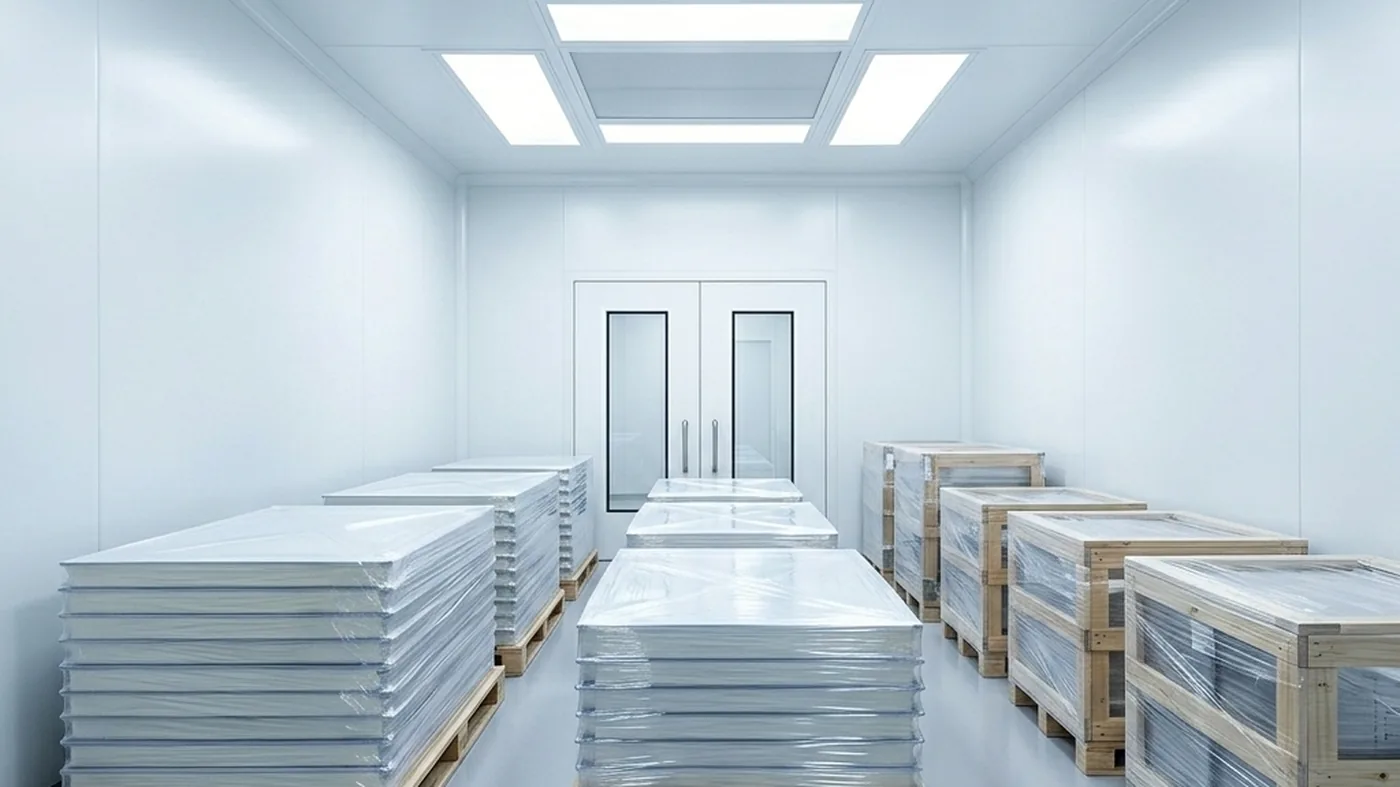
A modular cleanroom is not shipped as one finished box. It arrives as a kit of factory-made components that bolt together on site: insulated wall and ceiling panels, hermetic doors, view windows, coving, fan filter units (FFUs), HEPA filters, air handling/HVAC parts, and controls. This is why cleanrooms travel well across borders, the system flat-packs into standard sea containers and is assembled in your facility.
When you "import a cleanroom into the GCC", you are really managing four linked steps: manufacturing and pre-fabrication, sea freight to a Gulf port, customs clearance with conformity documents, and on-site installation plus validation. Treating these as one continuous project, rather than four separate problems, is what keeps the timeline and budget under control.
Pak Gusu manufactures turnkey cleanrooms in Lahore, Pakistan as the technical partner of GUSU Purification (China), and exports complete systems across the Gulf. We do not operate a Gulf office, so installation is arranged on a per-project basis at extra cost. Explore our cleanroom panels and services to see what ships.
Shipping Routes: Pakistan & China to the Gulf
Most GCC cleanroom imports move by sea, because volumetric panel cargo is far cheaper in a container than by air. The three primary entry ports are Jebel Ali (UAE), Dammam / King Abdul Aziz Port (Saudi Arabia) and Hamad (Qatar).
From Pakistan (Karachi/Port Qasim) and from China (Shanghai, Ningbo, Shenzhen), there are frequent direct and transhipment services into all three. Pakistan often has a shorter transit and simpler consolidation for Pak Gusu builds; China sailings are high-frequency with strong rates.
| Origin | Destination Port | Country | Typical Sea Transit |
|---|---|---|---|
| Karachi / Port Qasim | Jebel Ali | UAE | ~5–9 days |
| Karachi / Port Qasim | Dammam | Saudi Arabia | ~7–12 days |
| Karachi / Port Qasim | Hamad | Qatar | ~7–12 days |
| Shanghai / Ningbo | Jebel Ali | UAE | ~18–24 days |
| Shenzhen | Dammam | Saudi Arabia | ~22–30 days |
Transit times are general industry guidance and vary by carrier, season and transhipment. A typical small-to-mid cleanroom fits one or two 40ft containers; large pharmaceutical or hospital suites may need several. Use Jebel Ali if you want fast re-export or onward GCC trucking, it is the region's busiest hub.
Incoterms: CIF vs DAP (and Who Does What)
The Incoterm decides where the seller's responsibility ends and yours begins. For cleanroom imports, the two that matter most are CIF and DAP.
CIF (Cost, Insurance and Freight)
The seller pays freight and marine insurance to the named destination port (e.g. CIF Jebel Ali). Risk passes to you once goods are loaded at origin. You handle import customs clearance, duties, port charges and inland delivery to your site. CIF suits buyers who already have a customs broker and prefer to control clearance.
DAP (Delivered at Place)
The seller delivers the goods to your named site address, ready for unloading, but you remain the importer of record for customs duties and clearance formalities. DAP suits buyers who want a near-doorstep delivery and less freight coordination.
| Responsibility | CIF | DAP |
|---|---|---|
| Freight to port | Seller | Seller |
| Marine insurance | Seller | Seller (to site) |
| Import customs clearance | Buyer | Buyer |
| Duties & import taxes | Buyer | Buyer |
| Inland transport to site | Buyer | Seller |
| Unloading at site | Buyer | Buyer |
A practical tip, ask for the conformity documents (below) to be prepared before shipment regardless of Incoterm, because clearance delays, not freight, are the usual cause of slipped timelines. See our cost guide for how Incoterm choice affects landed price.
Customs & Conformity: SASO/SABER and ESMA
Cleanroom components are regulated goods in the Gulf, and conformity paperwork is mandatory. Get this wrong and your container sits at the port.
Saudi Arabia — SASO / SABER
Imports into Saudi Arabia must be registered on the SABER platform, with a Product Certificate of Conformity (PCoC) and a Shipment Certificate of Conformity (SCoC) issued through an approved Conformity Assessment Body. SASO sets the technical standards. Electrical and HVAC items (FFUs, fans, controls) typically require this conformity route before customs release at Dammam.
UAE — ESMA / ECAS
The Emirates Authority for Standardization and Metrology (ESMA, now part of MoIAT) operates the Emirates Conformity Assessment Scheme (ECAS) and product registration for regulated goods. Low-voltage electrical equipment and certain materials need an ECAS / Emirates Quality Mark route before clearance at Jebel Ali.
Qatar and wider GCC
Qatar applies GSO (GCC Standardization Organization) standards via its conformity scheme; align documentation with GSO and Qatar's requirements for Hamad port clearance.
Across all three, prepare a standard import pack:
- Commercial invoice and packing list
- Bill of lading
- Certificate of Origin (often attested)
- Conformity certificates (SABER PCoC/SCoC, ECAS as applicable)
- Material/technical data sheets and test reports
For regulated facilities, also align the design with the relevant health regulator, Saudi SFDA, UAE MOHAP / DHA / DoH and Dubai Civil Defence (DCD), and Qatar MoPH, plus EU-GMP Annex 1 (2022) and ISO 14644-1. Our systems are designed to meet these standards and are validation-ready. See Cleanroom UAE and Cleanroom Saudi Arabia for country specifics.
Lead Times, Installation & Validation
A realistic door-to-door timeline combines manufacturing, freight and clearance. The figures below are general planning guidance, your project may run faster or slower.
| Phase | Typical Duration |
|---|---|
| Design freeze & engineering | 1–3 weeks |
| Manufacturing / pre-fabrication | 3–6 weeks |
| Sea freight (Pakistan/China to Gulf) | 1–4 weeks |
| Customs clearance & inland delivery | 3–10 days |
| On-site installation | 1–4 weeks |
| Commissioning & validation | 1–2 weeks |
Installation
Modular panels are assembled on site by a fit-out crew, followed by FFU/HEPA mounting, HVAC connection, electrical, flooring and sealing. Pak Gusu can arrange installation supervision or a full install team at extra cost, since we have no permanent Gulf office, this is quoted per project and per emirate/region.
Validation
A cleanroom is only finished once it is tested and proven. Commissioning covers airflow, pressure cascade, recovery, and particle counts to confirm the ISO 14644-1 class (e.g. ISO 5 ≈ EU-GMP Grade A/B, ISO 7 ≈ Grade C, ISO 8 ≈ Grade D). Systems are delivered validation-ready so your qualified party can complete IQ/OQ/PQ. Browse pharmaceutical & nutraceutical applications, then request a quote with your target class, footprint and destination port.
Related pages
Planning a cleanroom in the Gulf?
Get a free, no-obligation quote — export pricing, lead times and installation across the GCC.
Frequently Asked Questions
Common questions about cleanrooms, standards, cost and how Pak Gusu supplies and installs across the GCC.
How long does it take to import a cleanroom into the GCC?
Plan 6 to 12 weeks door to door. That covers design freeze (1 to 3 weeks), manufacturing (3 to 6 weeks), sea freight from Pakistan or China (1 to 4 weeks), customs clearance (3 to 10 days), then on-site installation and validation. Pre-approved conformity documents are the single biggest factor in hitting the shorter end.
Should I choose CIF or DAP for a cleanroom shipment?
Choose DAP if you want the goods delivered to your site with minimal freight coordination; the seller handles inland transport while you remain importer of record. Choose CIF if you have a customs broker and prefer to control clearance from the destination port. Under both, you pay import duties and customs formalities.
Which port is best for GCC cleanroom imports?
Jebel Ali (UAE) is the busiest hub, ideal for fast clearance and onward GCC trucking. Use Dammam / King Abdul Aziz Port for Saudi Arabia and Hamad for Qatar. Pick the port closest to your final site to cut inland transport cost and time, and match it to the right conformity scheme.
Do I need SASO or SABER to import into Saudi Arabia?
Yes. Imports into Saudi Arabia must be registered on the SABER platform with a Product and Shipment Certificate of Conformity issued by an approved body, against SASO standards. Electrical and HVAC cleanroom components, such as fan filter units and controls, typically require this before customs release at Dammam.
What conformity documents does the UAE require?
Regulated electrical and material components usually need an ECAS (Emirates Conformity Assessment Scheme) certificate or Emirates Quality Mark via ESMA/MoIAT before Jebel Ali clearance. Standard import documents, commercial invoice, packing list, bill of lading, Certificate of Origin and technical data sheets, are also required.
Does Pak Gusu install the cleanroom on site in the Gulf?
Pak Gusu manufactures in Pakistan with GUSU China and exports across the GCC. We do not have a permanent Gulf office, so installation is arranged per project at extra cost, either supervision of a local crew or a full install team. Systems are delivered validation-ready for your qualified party to complete IQ/OQ/PQ.
Can a modular cleanroom really fit in a shipping container?
Yes. Modular cleanrooms ship flat-packed as panels, doors, FFUs, filters and HVAC parts in standard 20ft or 40ft sea containers, then assemble on site. A small-to-mid cleanroom often fits one or two 40ft containers, while large pharmaceutical or hospital suites may need several containers.
Cleanrooms supplied & installed across the GCC
Manufactured in Pakistan with GUSU (China) technology · shipped to Jebel Ali, Dammam & Hamad (CIF/DAP) · installation available across the Gulf.