
ISO 14644 cleanroom classes rank air cleanliness from ISO 1 (cleanest) to ISO 9 (least clean) by the maximum number of airborne particles allowed per cubic metre at defined sizes. ISO 5-8 cover most pharma and healthcare work: ISO 5 for aseptic filling, ISO 7-8 for support areas. The class sets particle limits only; airflow, gowning, and monitoring define how you meet it.
Key takeaways
- ISO 14644-1:2015 defines nine classes (ISO 1-9) by particle counts per m³ at 0.1-5 µm.
- Lower ISO number = cleaner air; each step up the class scale allows 10x more particles.
- ISO 5 ≈ EU-GMP Grade A/B; ISO 7 ≈ Grade C; ISO 8 ≈ Grade D — but GMP adds in-operation and viable limits.
- Most Gulf pharma cleanrooms combine ISO 5 fill zones inside ISO 7-8 background rooms.
- Classification proves design intent; routine monitoring and qualification prove ongoing compliance.
What ISO 14644-1 Actually Classifies
ISO 14644-1:2015 is the international standard that classifies cleanroom air by the concentration of airborne particles. It defines nine classes, ISO 1 to ISO 9, where ISO 1 is the cleanest and ISO 9 is closest to ordinary indoor air. Classification is based on the maximum permitted number of particles per cubic metre at one or more chosen particle sizes between 0.1 µm and 5 µm.
The class number is a power of ten. The particle limit at 0.1 µm for any class is 10 raised to that class number — so ISO 5 allows 10⁵ (100,000) particles ≥0.1 µm per m³, ISO 6 allows 10⁶, and so on. This is why moving one class "dirtier" permits roughly ten times more particles.
A few points that are often misunderstood:
- ISO 14644-1 only sets particle-count limits. It does not, by itself, dictate airflow, air changes, gowning, or microbial (viable) limits.
- Classification can be specified "at rest" (room built and running, no people or process) or "in operation" (full activity). You must state which.
- Microbial monitoring, recovery testing, and other tests live in companion parts (ISO 14644-2, -3) and in EU-GMP Annex 1, not in the class number itself.
For Gulf manufacturers and importers, this matters: a supplier quoting "ISO 7" is describing a particle target, not a complete validated environment. The room still needs the right HVAC, filtration, and qualification to hold that class in use.
The ISO 14644-1 Particle-Count Table (ISO 1-9)
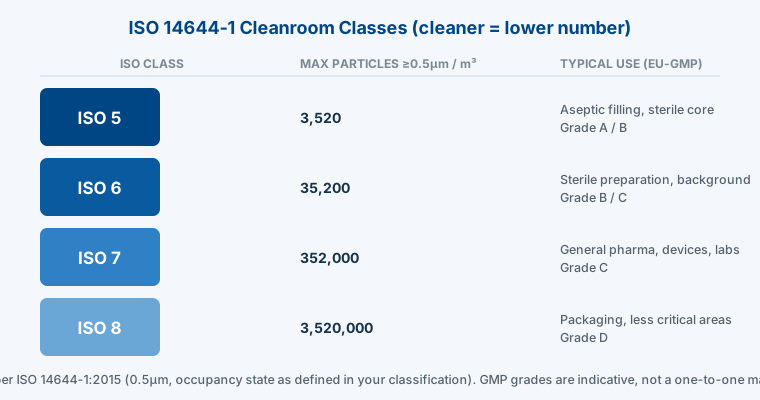
The table below shows the maximum allowable particle concentrations (particles per cubic metre of air) for each ISO class, by particle size. These are the limits in ISO 14644-1:2015. Blank cells indicate sizes not applicable for classification at that class (concentrations either too low to measure reliably or not used).
| ISO Class | ≥0.1 µm | ≥0.2 µm | ≥0.3 µm | ≥0.5 µm | ≥1 µm | ≥5 µm |
|---|---|---|---|---|---|---|
| ISO 1 | 10 | — | — | — | — | — |
| ISO 2 | 100 | 24 | 10 | — | — | — |
| ISO 3 | 1,000 | 237 | 102 | 35 | — | — |
| ISO 4 | 10,000 | 2,370 | 1,020 | 352 | 83 | — |
| ISO 5 | 100,000 | 23,700 | 10,200 | 3,520 | 832 | — |
| ISO 6 | 1,000,000 | 237,000 | 102,000 | 35,200 | 8,320 | 293 |
| ISO 7 | — | — | — | 352,000 | 83,200 | 2,930 |
| ISO 8 | — | — | — | 3,520,000 | 832,000 | 29,300 |
| ISO 9 | — | — | — | 35,200,000 | 8,320,000 | 293,000 |
How to read it: pick the particle size relevant to your process (0.5 µm is the most common reference for pharma cleanrooms), then find the class whose limit your measured count stays under. A room measuring 280,000 particles ≥0.5 µm per m³, for example, passes ISO 7 (limit 352,000) but fails ISO 6.
Note the ≥5 µm column for ISO 7-9. EU-GMP historically tracked the 5 µm size closely for Grades A-D; the 2022 Annex 1 revision retained 5 µm limits for in-operation Grade A and B as an early indicator of contamination, so this size still matters for Gulf pharma producers exporting under EU-aligned expectations.
What Each Class Is Used For
Cleaner is not always better — over-specifying a class wastes capital and running cost. The right class follows the process risk. Here is how ISO 5-8 (the working range for most pharma and healthcare) typically map to applications relevant to Gulf facilities.
ISO 5 — Critical / aseptic zones
Used where product is exposed and cannot be terminally sterilised: aseptic filling lines, open vial or ampoule handling, sterile compounding, and the critical work zone under a laminar-flow hood or RABS/isolator. ISO 5 is almost always achieved as a localised zone (unidirectional airflow) inside a cleaner background room.
ISO 6 — High-grade support
A buffer or transition grade — gowning-critical areas and immediate surrounds of ISO 5 zones in some designs. Less common as a standalone room target in pharma; more often a step between Grade A/B cores and Grade C backgrounds.
ISO 7 — Background and preparation
The workhorse "clean" background: solution preparation, equipment prep, filling-room backgrounds around ISO 5 zones, and many compounding pharmacy main rooms. Typical air-change rates and HEPA coverage make ISO 7 a practical, validatable target.
ISO 8 — General controlled areas
Material airlocks, warehousing of clean components, packaging of sealed product, and lower-risk support spaces. Many medical-device assembly and non-sterile pharma operations run at ISO 8.
- ISO 1-4: ultra-clean — semiconductor, microelectronics, nanotech. Rare in pharma/healthcare.
- ISO 5-8: the pharma, biotech, sterile-compounding, and medical-device range.
- ISO 9: lightly controlled space, cleaner than a normal room but minimal classification.
Pak Gusu cleanrooms are designed to meet ISO 14644-1 targets across this range, with modular panel and HVAC systems specified to the class your process and regulator require. See our pharmaceutical and nutraceutical solutions for sector-specific layouts.
How ISO 14644 Maps to EU-GMP Grades
Gulf regulators — Saudi SFDA, UAE MOHAP/DHA/DoH, and Qatar MoPH — generally expect EU-GMP-aligned standards for sterile and pharmaceutical manufacturing, alongside WHO guidance. EU-GMP Annex 1 (2022) uses Grades A, B, C, D rather than ISO numbers, but the two systems align on particle counts. The key difference: GMP grades specify BOTH at-rest and in-operation particle limits AND microbial (viable) limits, whereas the ISO class is particle-count only.
| EU-GMP Grade | ISO 14644 equivalent (at rest) | Typical use |
|---|---|---|
| Grade A | ISO 5 (at rest and in operation) | Aseptic filling, critical exposed product |
| Grade B | ISO 5 at rest / ISO 7 in operation | Background to Grade A for aseptic processing |
| Grade C | ISO 7 at rest / ISO 8 in operation | Preparation of solutions, less critical stages |
| Grade D | ISO 8 at rest | Clean support, component handling |
Important caveats for compliance teams:
- The mapping is an equivalence of particle limits, not a substitution. A room "classified ISO 7" is not automatically "Grade C compliant" — Grade C also requires in-operation particle control and defined viable limits (settle plates, active air sampling, contact plates).
- Grade A and B are assessed in operation as well as at rest; Grade A must hold ISO 5 during activity, which is demanding and usually needs unidirectional airflow plus isolators or RABS.
- Annex 1 (2022) strengthened expectations on contamination control strategy (CCS), so the environment around the cleanroom — gowning, transfer, monitoring — is judged as a whole.
Use "designed to meet" and "validation-ready" language when planning: a well-designed ISO 7 room is built to support Grade C qualification, but the GMP grade is earned through qualification and ongoing monitoring, not assigned by the class alone. For budgeting these tiers, see our cleanroom cost guide for the UAE and Saudi Arabia.
Choosing and Proving Your Class in the Gulf
Selecting a class is a risk decision, not a default. Work backwards from the product and the regulator.
Step 1 — Define process risk
Is product exposed? Is it terminally sterilised or aseptically processed? Exposed sterile product drives an ISO 5 / Grade A critical zone; sealed or terminally sterilised product may need only ISO 7-8 backgrounds.
Step 2 — Confirm the regulator's expectation
For sterile manufacture, SFDA, MOHAP, DHA, DoH, and MoPH lean on EU-GMP Annex 1 and WHO. Map your ISO target to the matching grade and design to the stricter in-operation requirement.
Step 3 — Design the cleanliness cascade
Use pressure cascades and airlocks so cleaner rooms sit at higher pressure. A typical sterile suite nests an ISO 5 zone inside ISO 7, inside ISO 8 airlocks. Panel integrity, sealed finishes, and HEPA filtration make the target achievable — explore our cleanroom wall and ceiling panels.
Step 4 — Classify and qualify
Classification (ISO 14644-1) measures particle counts at the required sample locations. Full qualification (DQ/IQ/OQ/PQ) plus routine environmental monitoring proves the room holds its class and grade over time. We can support installation and validation-ready handover; installation across the GCC is available at additional cost.
Pak Gusu manufactures modular cleanroom systems in Pakistan and exports across the Gulf — to Jebel Ali, Dammam (King Abdul Aziz Port), and Hamad — on CIF or DAP terms, as a technical partner of GUSU Purification (China). To scope a class-appropriate system for your facility, request a tailored quote via our get a quote page or review our full cleanroom services.
Related pages
Planning a cleanroom in the Gulf?
Get a free, no-obligation quote — export pricing, lead times and installation across the GCC.
Frequently Asked Questions
Common questions about cleanrooms, standards, cost and how Pak Gusu supplies and installs across the GCC.
What is the cleanest ISO 14644 cleanroom class?
ISO 1 is the cleanest class under ISO 14644-1, permitting only 10 particles ≥0.1 µm per cubic metre. It is used in ultra-sensitive semiconductor and nanotechnology work. Pharmaceutical and healthcare facilities rarely need anything cleaner than ISO 5, which covers aseptic filling and critical sterile zones.
What ISO class is equivalent to EU-GMP Grade A?
EU-GMP Grade A corresponds to ISO 5 both at rest and in operation. However, Grade A adds requirements the ISO class does not: defined viable (microbial) limits, in-operation particle control, and usually unidirectional airflow with isolators or RABS. Meeting ISO 5 particle counts is necessary but not sufficient for Grade A compliance.
What is the difference between ISO 7 and ISO 8 cleanrooms?
ISO 7 allows up to 352,000 particles ≥0.5 µm per m³, while ISO 8 allows ten times more, up to 3,520,000. ISO 7 suits preparation rooms and backgrounds around critical zones; ISO 8 suits airlocks, component handling, and general controlled areas. ISO 7 typically requires higher air-change rates and HEPA coverage.
Does an ISO 14644 class guarantee GMP compliance?
No. ISO 14644-1 classifies particle counts only. EU-GMP grades, which Gulf regulators like SFDA and MOHAP expect for sterile manufacture, add in-operation limits and microbial monitoring. A room designed to an ISO class is built to support the matching grade, but GMP compliance is earned through qualification and ongoing environmental monitoring.
How is a cleanroom's ISO class measured?
An accredited test measures airborne particle concentrations with a calibrated counter at a required number of sample locations across the room, per ISO 14644-1:2015. Counts at the chosen particle size (often 0.5 µm) must stay below the class limit at every location. Tests are run at rest or in operation, as specified.
Which ISO class do most Gulf pharma cleanrooms use?
Most sterile Gulf pharma facilities combine classes: an ISO 5 critical zone for aseptic filling nested inside an ISO 7 background room, with ISO 8 airlocks and material transfer areas. Non-sterile and packaging operations often run at ISO 8. The exact mix follows product risk and EU-GMP Annex 1 expectations.
Why does ISO 14644 still track 5 µm particles?
Larger 5 µm particles signal gross contamination or process upset, so they act as an early warning. EU-GMP Annex 1 (2022) retained 5 µm in-operation limits for Grades A and B, and ISO 14644-1 lists 5 µm limits for ISO 7-9. For Gulf exporters under EU-aligned rules, monitoring this size remains relevant.
Cleanrooms supplied & installed across the GCC
Manufactured in Pakistan with GUSU (China) technology · shipped to Jebel Ali, Dammam & Hamad (CIF/DAP) · installation available across the Gulf.