
A modular cleanroom is built from prefabricated wall, ceiling and service panels assembled on site, while a conventional (stick-built) cleanroom is constructed in place from drywall, sealants and traditional trades. Modular delivers faster installation, predictable cost, easy reconfiguration and cleaner validation; conventional offers fixed-shell permanence. For most Gulf pharma, medical-device and electronics projects facing tight deadlines, modular wins on speed and flexibility.
Key takeaways
- Modular cleanrooms install in weeks, not months — critical for aggressive Gulf timelines and Ramadan/summer scheduling.
- Prefab panels arrive factory-finished, cutting on-site trades, dust and rework versus stick-built construction.
- Modular systems are easier to expand, relocate or upgrade as production needs change.
- Both routes can achieve ISO 14644-1 and EU-GMP Annex 1 grades — quality depends on design and validation, not the method alone.
- Pak Gusu ships modular cleanroom systems across the GCC via Jebel Ali, Dammam and Hamad; installation available at extra cost.
What's the Difference Between Modular and Conventional Cleanrooms?
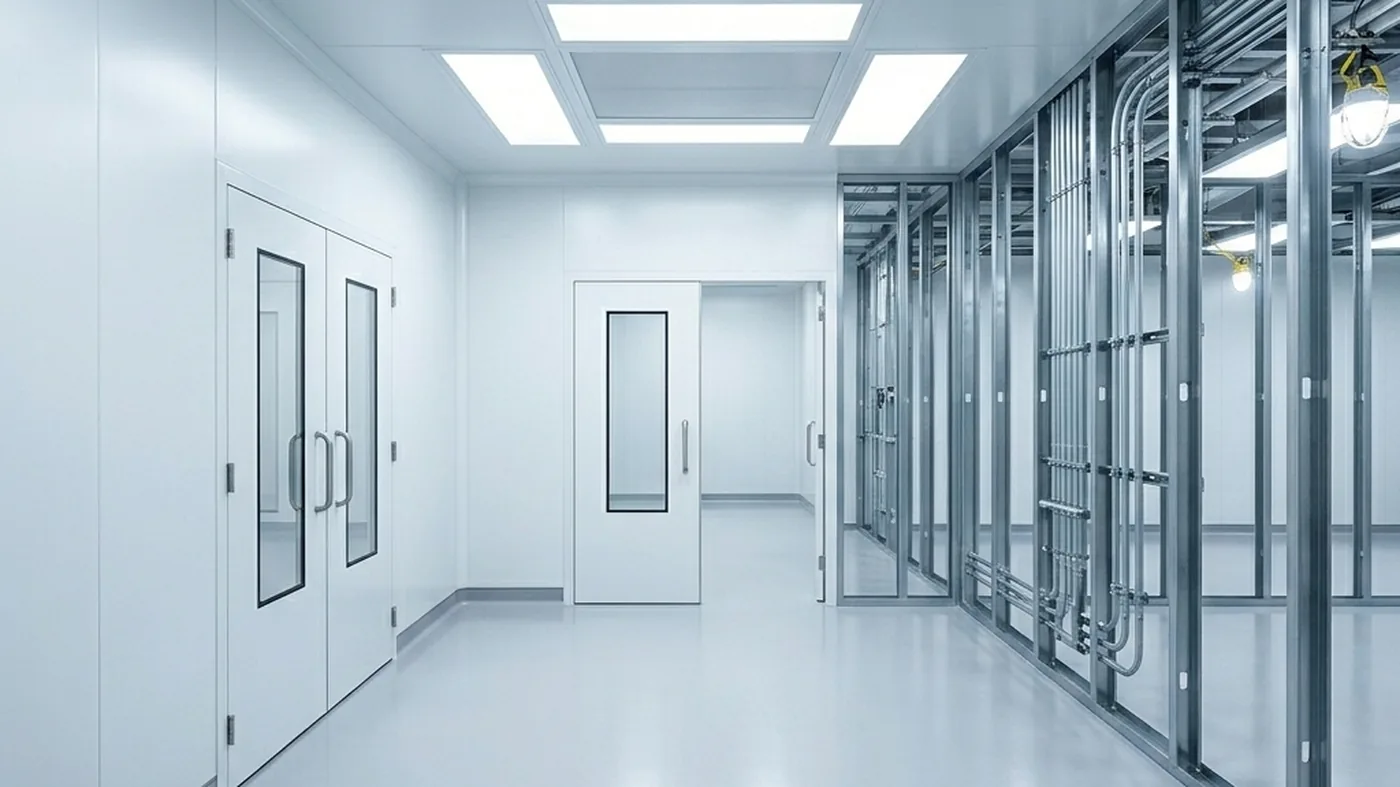
The core distinction is how the room is built. A modular cleanroom uses prefabricated, factory-finished components — typically insulated or honeycomb wall panels, walkable ceiling grids, flush-mounted doors, windows and integrated service chases — that are manufactured off site, shipped to the project and bolted together. The structure is essentially a high-spec kit.
A conventional cleanroom (often called stick-built) is constructed in place using traditional building methods: metal-stud framing, gypsum board, epoxy paint or coatings, applied sealants, and site-fabricated ceilings. Each surface is built up by trades on the floor, then cleaned and sealed.
Both approaches can deliver any cleanliness class — from ISO 8 (EU-GMP Grade D) gowning areas up to ISO 5 (Grade A/B) aseptic zones. The method does not cap the achievable grade; design, airflow strategy and validation discipline do. What changes between the two is *how fast you get there, how the cost behaves, and how easily you can change it later* — exactly the variables that matter most on Gulf projects.
For a deeper primer on the underlying particle-count classes, see our guide to <a href="/products/cleanroom-panels/">cleanroom panels</a> and wall systems.
Speed: Why Modular Wins on Gulf Timelines
Speed is where modular separates itself most clearly, and it is the single biggest reason GCC project owners choose it.
Because panels, doors and ceiling systems are fabricated in a controlled factory *while* civil and MEP first-fix work proceeds on site, the two streams run in parallel rather than in sequence. When components land at Jebel Ali, Dammam or Hamad, assembly is a matter of bolting a pre-engineered system together — not waiting on plaster to cure, paint to dry, or multiple trades to finish in turn.
Typical timeline comparison
| Phase | Modular | Conventional (stick-built) |
|---|---|---|
| Design & engineering | 2-4 weeks | 3-6 weeks |
| Fabrication (off-site) | Parallel with site prep | Not applicable |
| On-site build / assembly | 2-5 weeks | 8-16 weeks |
| Cleaning & sealing | Minimal (factory-finished) | Extended (site-applied) |
| Validation readiness | Faster, fewer surprises | Longer snag/seal cycle |
*Ranges are general industry guidance and vary by room size, grade and site readiness.*
This speed advantage compounds in the Gulf, where project calendars are squeezed by summer heat windows, Ramadan working hours, and licensing milestones tied to regulators such as the Saudi SFDA, UAE MOHAP/DHA/DoH and Qatar MoPH. Shaving two to three months off the build directly shortens time-to-licence and time-to-revenue. See how this plays out across the region in <a href="/cleanroom-uae/">cleanrooms in the UAE</a> and <a href="/cleanroom-saudi-arabia/">Saudi Arabia</a>.
Cost: Upfront Price vs Total Cost of Ownership
Comparing cost fairly means looking past the headline panel price.
Conventional construction can appear cheaper per square metre on paper, especially for very large, fixed shells where economies of scale favour bulk drywall. But stick-built carries hidden costs: longer site labour, more trades, snagging, rework on failed seals, and the opportunity cost of a facility that opens months later.
Modular front-loads engineering and material quality but compresses the expensive on-site phase. Factory finishing reduces labour hours, dust-related rework and validation failures. Crucially for the Gulf, it also reduces the duration of expatriate trade mobilisation and site overheads.
- Modular cost drivers: panel specification, door/window count, HVAC integration, shipping (CIF/DAP), optional installation.
- Conventional cost drivers: sustained site labour, trade coordination, coatings, extended programme, snagging and re-seals.
- Long-term: modular panels can be cleaned, modified or relocated; stick-built changes mean demolition and rebuild.
For a structured view of regional pricing variables, see our <a href="/cleanroom-cost-uae-saudi-arabia/">cleanroom cost guide for the UAE and Saudi Arabia</a>. As a general rule, the larger the role of *time* and *future change* in your business case, the stronger modular's total-cost-of-ownership advantage.
Flexibility, Quality and Validation
Flexibility
Production needs in pharma, nutraceutical and medical-device manufacturing rarely stand still. Modular cleanrooms are designed to be reconfigured: panels can be removed, added or relocated to expand a suite, add an airlock, or repurpose a Grade C area into Grade B. Stick-built changes typically mean breaking, dust generation, recoating and full re-validation of the affected zone. If your roadmap includes scaling lines or adding products, modular's demountability is a genuine commercial asset.
Quality
Factory fabrication brings tight tolerances, flush surfaces, coved corners and consistent finishes that resist particle shedding and support cleaning regimes. Conventional builds can match this quality, but only with rigorous site control — every joint, coat and seal is a chance for variance. Modular reduces the number of in-field variables.
Validation
Both methods must be validated to the same evidence standards — IQ/OQ/PQ, particle counts to ISO 14644-1, and contamination-control expectations under EU-GMP Annex 1 (2022) and WHO guidance. Modular's advantage is fewer field-applied seals and cleaner documentation: standardised, repeatable components are easier to qualify and re-qualify. Our systems are *designed to meet and built validation-ready* against ISO 14644, ISO 13485 quality-system needs and GSO requirements. Learn more about our <a href="/services/">design, validation-support and after-sales services</a>.
Which Should You Choose for Your Gulf Project?
There is no universally "better" option — there is the option that fits your constraints. Use this quick decision guide.
| If your priority is... | Lean toward... |
|---|---|
| Fast time-to-licence and revenue | Modular |
| Future expansion or line changes | Modular |
| Tight, predictable cost & programme | Modular |
| A permanent, never-changing fixed shell | Conventional |
| Highly irregular existing-building geometry | Either (modular adapts well) |
| Minimal on-site dust and trades | Modular |
For the overwhelming majority of GCC pharmaceutical, nutraceutical, medical-device and electronics facilities — where deadlines are aggressive, regulators expect documented contamination control, and businesses need room to grow — modular is the pragmatic default.
Pak Gusu manufactures cleanroom systems in Pakistan as the technical partner of GUSU Purification (China) and exports across the GCC under CIF or DAP terms through Jebel Ali, Dammam and Hamad. We do not operate a Gulf office, but we ship complete modular systems and offer installation at extra cost. Explore solutions by sector on our <a href="/industries/pharmaceutical-nutraceutical/">pharmaceutical and nutraceutical</a> page, then <a href="/get-quote/">request a quote</a> with your grade, area and timeline.
Related pages
Planning a cleanroom in the Gulf?
Get a free, no-obligation quote — export pricing, lead times and installation across the GCC.
Frequently Asked Questions
Common questions about cleanrooms, standards, cost and how Pak Gusu supplies and installs across the GCC.
Is a modular cleanroom as good as a conventional one for GMP?
Yes. Modular cleanrooms can meet the same ISO 14644-1 classes and EU-GMP Annex 1 grades as conventional builds. GMP compliance depends on design, airflow, contamination control and validation — not the construction method. Modular often validates more cleanly because factory-finished panels reduce field-applied seals and documentation variance.
How much faster is a modular cleanroom to build?
On-site assembly of a modular cleanroom typically takes 2-5 weeks versus roughly 8-16 weeks for stick-built construction, because panels are fabricated off site in parallel with civil works. Actual savings depend on room size, cleanliness grade and site readiness, but a saving of two to three months is common on Gulf projects.
Are modular cleanrooms cheaper than conventional ones?
It depends on how you measure. Conventional can look cheaper per square metre upfront, but modular usually wins on total cost of ownership thanks to shorter site labour, less rework, faster validation and the ability to reconfigure rather than demolish. The more time and future change matter to your business case, the stronger modular's cost advantage.
Can a modular cleanroom be expanded or relocated later?
Yes — this is a key modular advantage. Panels and ceiling systems are demountable, so you can extend a suite, add airlocks, change a grade, or relocate the room with far less disruption than stick-built. Conventional changes usually require demolition, recoating and re-validation of the affected area.
Does Pak Gusu install cleanrooms in the Gulf?
Pak Gusu manufactures and exports modular cleanroom systems across the GCC via Jebel Ali, Dammam and Hamad under CIF or DAP terms. We do not maintain a Gulf office, but installation is available at extra cost, and we provide design and validation-ready documentation support to your local team or contractor.
Which cleanroom grades can modular systems achieve?
Modular systems can achieve every standard grade, from ISO 8 (EU-GMP Grade D) gowning and material-prep areas to ISO 5 (Grade A/B) aseptic zones, matching ISO 7 for Grade C. The achievable class is set by airflow design, filtration and validation, not by whether the room is modular or stick-built.
Cleanrooms supplied & installed across the GCC
Manufactured in Pakistan with GUSU (China) technology · shipped to Jebel Ali, Dammam & Hamad (CIF/DAP) · installation available across the Gulf.