
A cleanroom air shower is an interlocked entry chamber that blasts personnel or materials with high-velocity, HEPA-filtered air — typically 20–25 m/s from adjustable stainless-steel nozzles — to strip loose particles from garments and surfaces before entry into the cleanroom. A standard cycle runs 10–30 seconds, during which both doors stay electromagnetically locked so unfiltered corridor air can never pass straight through into the classified space.
Pak Gusu Technology manufactures personnel, cargo and tunnel air showers in Lahore as the technical partner of GUSU Purification (China), and exports them on CIF/DAP terms to the UAE, Saudi Arabia, Qatar, Kuwait, Bahrain and Oman. Each unit is built to integrate flush with our cleanroom panel systems and cleanroom doors, and ships pre-wired and factory-tested. To size and specify a unit for your facility, request a quote.
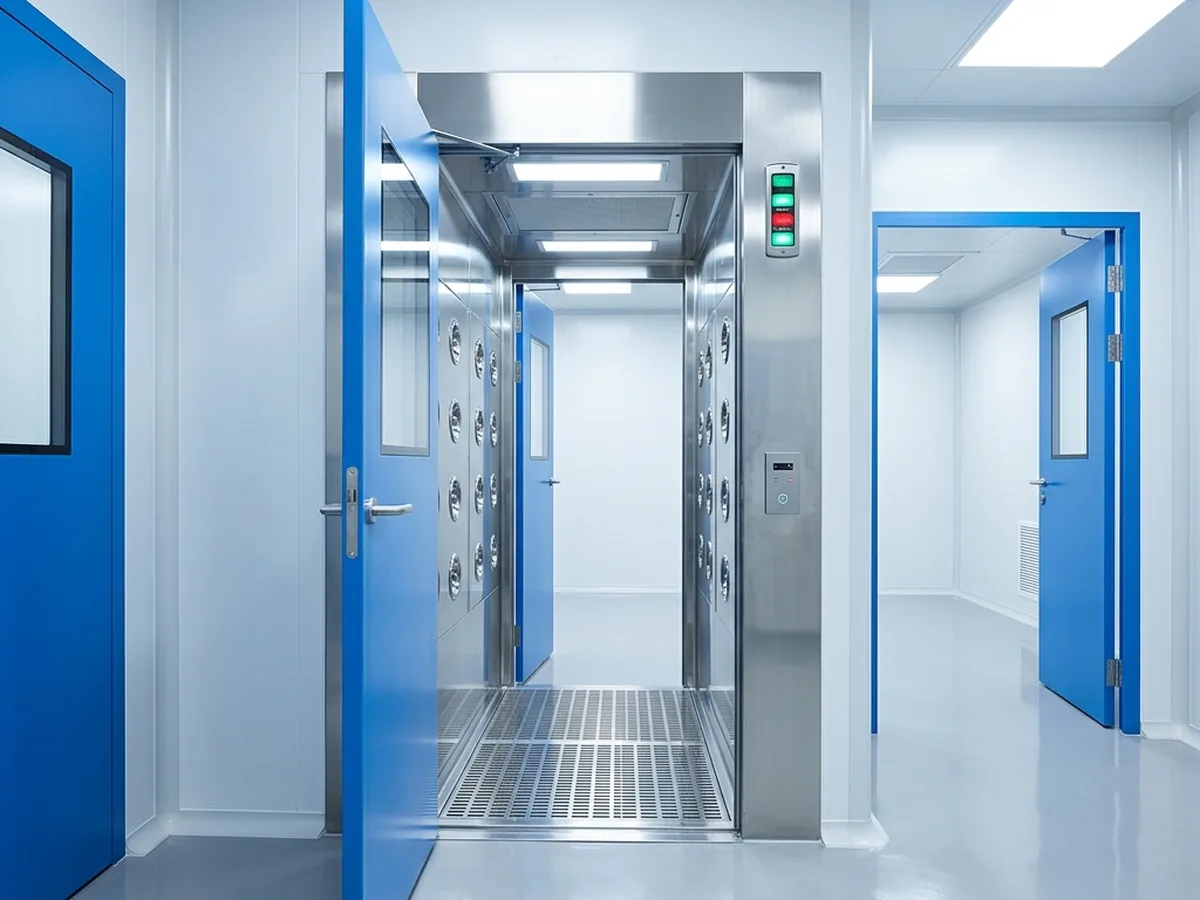
Key takeaways
- HEPA-filtered jets at roughly 20–25 m/s dislodge loose particles from garments during a 10–30 second interlocked cycle.
- Filtration is two-stage: a G4 pre-filter plus an H13 or H14 HEPA filter graded to EN 1822; air recirculates within the unit.
- Built in powder-coated steel, SS304 or SS316L, in single-person to multi-person, L-type, U-type and tunnel/cargo formats.
- Electromagnetic door interlocks with emergency release come as standard; PLC control with HMI is available as an option.
- Units ship pre-wired CIF/DAP via Jebel Ali, King Abdulaziz Port Dammam and Hamad Port; installation supervision is available at extra cost.
How Does a Cleanroom Air Shower Work?
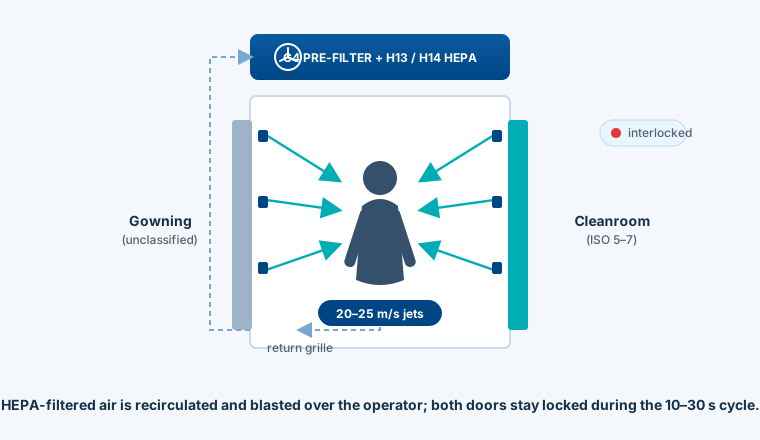
An air shower recirculates air through a fan unit, a G4 pre-filter and an H13 or H14 HEPA filter, then discharges it through adjustable stainless-steel nozzles at high velocity. The jets create enough shear at the garment surface to dislodge loosely held particles, which are drawn back through the return grilles and captured on the filters instead of riding into the cleanroom.
- Entry: the operator steps in from the unclassified side; both doors lock electromagnetically and the cycle starts by push button or infrared sensor.
- Jetting: nozzles discharge HEPA-filtered air at roughly 20–25 m/s for an adjustable 10–30 second cycle while the operator raises their arms and turns slowly so the jets sweep every surface.
- Release: the jets stop, the chamber stabilises briefly, and only the cleanroom-side door unlocks — the corridor-side door remains locked throughout.
Because the two doors can never open together, the air shower also functions as an airlock, removing any direct air path between corridor and classified space. It supplements gowning discipline; it does not replace it.
Where Is an Air Shower Required?
An air shower sits at the final transition into the cleanroom — normally between the change (gowning) room and production areas running at ISO Class 5–7, where airborne particle limits are tightest. Neither ISO 14644 nor EU-GMP Annex 1 mandates an air shower by name; it is specified as part of a facility's contamination-control strategy, and it is standard practice in pharmaceutical, food and beverage, and electronics plants across the Gulf.
- Personnel air showers at the gowning-to-cleanroom entry, sized for one or several people per cycle to match shift-change throughput.
- Cargo and tunnel air showers at material entries, with full-width doors and flush or ramped thresholds for trolleys, drums and palletised goods.
- Small material transfer is usually better served by a pass box — see our pass-through chambers.
Construction, Sizes and Configurations
Pak Gusu air showers are fabricated in three material grades: powder-coated steel for general dry environments, SS304 stainless steel for hygienic production environments, and SS316L where frequent chemical wipe-down or washdown is expected. Nozzles are adjustable stainless steel as standard, so the jet pattern can be aimed during commissioning.
- Single-person and two-person straight-through chambers for standard gowning-room exits.
- Multi-person and channel units that clear larger teams per cycle at shift change.
- L-type and U-type layouts where the entry and exit must turn a corner, or where a one-way personnel flow is enforced.
- Tunnel and cargo showers for continuous walk-through traffic or wheeled material loads.
Every unit is dimensioned to pocket neatly into our modular wall systems, with door swings, vision panels and frame details matched to the adjoining cleanroom doors so the airlock reads as part of the envelope, not an afterthought.
Controls, Interlocks and Safety
Door management is the heart of an air shower, and it is engineered conservatively:
- Electromagnetic interlocks prevent both doors opening at once, holding the airlock condition through the full cycle.
- Emergency release de-energises the locks on power failure or alarm, so the chamber never traps an occupant — an essential life-safety behaviour.
- Microprocessor controller as standard, with adjustable cycle timer, door-status indication and cycle-count display; a PLC with HMI touch panel is available where the unit must report to a building or environmental monitoring system.
- Automatic start by infrared occupancy sensor or push button, with LED status lights on both faces showing when entry is permitted.
- Maintenance access to pre-filters and HEPA filters from inside or above the unit, without breaking the cleanroom envelope.
Air Shower Specification (Typical)
The figures below are typical ranges for standard units; every air shower is built to order, so dimensions and options are confirmed at design stage.
| Parameter | Typical specification / options |
|---|---|
| Internal size (single person) | Approx. 800 × 1,000 × 1,950 mm (W × D × H); multi-person, cargo and tunnel units built to order |
| Nozzle jet velocity | Approx. 20–25 m/s at the nozzle outlet, adjustable |
| Nozzles | Adjustable stainless steel, typically 8–24 per person position (side walls and ceiling) |
| HEPA filter | H13 (≥99.95% at MPPS) or H14 (≥99.995% at MPPS), graded to EN 1822 |
| Pre-filter | G4 panel filter, tool-free replacement |
| Cycle time | Adjustable, typically set 10–30 s (timer range up to 99 s) |
| Power supply | 220–240 V single-phase or 380–415 V three-phase, 50 or 60 Hz to suit the destination country; blower approx. 0.55–1.5 kW per section |
| Body material | Powder-coated steel, SS304 or SS316L |
| Door interlock | Electromagnetic with emergency release; PLC + HMI control optional |
For a full submittal-ready datasheet against your room classification, request a quote with your door schedule and headcount per shift.
Air Shower vs Pass Box: Which Do You Need?
Buyers often weigh an air shower against a pass box, but they solve different problems and most facilities need both.
| Aspect | Air shower | Pass box (pass-through) |
|---|---|---|
| What passes through | People, trolleys, palletised goods | Small items: tools, documents, components, vials |
| Decontamination method | High-velocity HEPA-filtered jets (~20–25 m/s) | Static interlock, or laminar-flow / UV options |
| Format | Walk-in or drive-in floor-standing chamber | Compact hatch built into the wall |
| Typical location | Gowning room to cleanroom entry; material airlocks | Between adjacent rooms of different classification |
Most facilities specify both: a personnel air shower at the gowning exit and pass boxes between adjacent rooms of different classification. If you are weighing a laminar-flow pass box against a cargo shower for a material route, send us the layout and our engineers will recommend the right device for each opening — unfamiliar terms such as airlock, interlock and laminar flow are defined in our cleanroom glossary.
How Do We Deliver and Install Air Showers in the GCC?
Air showers ship from Pakistan factory-assembled or in knock-down form, pre-wired and function-tested, on CIF or DAP terms through Jebel Ali (UAE), King Abdulaziz Port Dammam (Saudi Arabia) and Hamad Port (Qatar), with onward delivery across Kuwait, Bahrain and Oman. Site installation and commissioning supervision by our engineers is available at extra cost — most contractors can set a pre-wired unit with our drawings and remote support alone. Logistics, duties and site-readiness checklists are detailed on our shipping and installation in the GCC page.
If the air shower is part of a wider fit-out, start with our cleanrooms for the GCC overview, or scope the whole facility first with the cleanroom cost calculator. For drawings, datasheets and lead times, call or WhatsApp +92 321 8073738, or email info@pakgusu.com.
Related pages
Ready to start your GCC cleanroom project?
Get a free, no-obligation quote — export pricing, lead times and installation across the GCC.
Frequently Asked Questions
Common questions about cleanrooms, standards, cost and how Pak Gusu supplies and installs across the GCC.
Are you an air shower supplier and manufacturer in Saudi Arabia, the UAE, Kuwait and the GCC?
Yes. Pak Gusu manufactures personnel, cargo and tunnel air showers in Lahore, Pakistan and exports them across all six GCC countries — Saudi Arabia, the UAE, Qatar, Kuwait, Bahrain and Oman — on CIF or DAP terms via Jebel Ali, Dammam and Hamad ports. Units ship pre-wired with HEPA filters and interlocked doors. We have no local Gulf office; installation supervision is available at extra cost.
How long does an air shower cycle take?
A typical air shower cycle runs 10 to 30 seconds, set on an adjustable timer that usually ranges up to 99 seconds. The duration is fixed during commissioning to balance particle removal against personnel throughput at shift change. Both doors remain electromagnetically interlocked for the whole cycle.
Is an air shower mandatory for an ISO 7 or GMP cleanroom?
No standard mandates an air shower by name: ISO 14644 sets particle limits and EU-GMP Annex 1 requires a documented contamination-control strategy, but both leave entry design to the facility. In practice air showers are widely specified for ISO Class 5–7 and GMP-classified production because they reduce the particle load carried in on garments. Pak Gusu can advise whether one is justified for your classification and process.
What HEPA grade does a cleanroom air shower use?
Most air showers use an H13 HEPA filter, rated at least 99.95% efficient at the most penetrating particle size under EN 1822, with H14 (99.995%) specified for stricter pharmaceutical applications. A G4 pre-filter upstream protects the HEPA and extends its service life. Both filters are replaceable without breaking the cleanroom envelope.
Can an air shower handle trolleys and palletised goods?
Yes — cargo and tunnel air showers are built with full-width doors, reinforced floors and flush or ramped thresholds so trolleys and pallet trucks can pass straight through. Nozzles are arranged on both side walls and the ceiling to sweep large load surfaces. For small items, a wall-mounted pass box is usually the more practical choice.
Do you supply air showers to the UAE and Saudi Arabia?
Yes. Pak Gusu manufactures air showers in Lahore, Pakistan and exports them on CIF or DAP terms via Jebel Ali, King Abdulaziz Port Dammam and Hamad Port, covering all six GCC states. Units arrive pre-wired and factory-tested, and installation supervision by our engineers is available at extra cost. Contact +92 321 8073738 or info@pakgusu.com to start a specification.
What is the difference between an air shower and a pass box?
An air shower is a walk-in or drive-in chamber that uses high-velocity HEPA-filtered jets to clean personnel and large materials entering the cleanroom. A pass box is a compact interlocked hatch set into the wall for transferring small items between rooms of different classification, available in static or laminar-flow versions. Most cleanroom facilities use both, at different points in the people and material flows.
Cleanrooms supplied & installed across the GCC
Manufactured in Pakistan with GUSU (China) technology · shipped to Jebel Ali, Dammam & Hamad (CIF/DAP) · installation available across the Gulf.