
A fan filter unit (FFU) is a self-contained ceiling module that combines a motorised fan and an H13 or H14 HEPA filter in one housing, supplying filtered air downwards into the cleanroom at a controlled face velocity of typically 0.3–0.45 m/s. Mounted in the ceiling grid, each FFU draws air from the plenum above and delivers it through the filter face, so cleanliness can be scaled room by room without depending entirely on a central air handler.
Pak Gusu Technology manufactures FFUs in the two industry-standard nominal sizes — 1175 × 575 mm (2×4) and 1175 × 1175 mm (4×4) — with a choice of AC or energy-efficient EC motors, room-side replaceable filters and optional group control. Units are designed to integrate directly with our walkable and T-grid ceiling systems and ship to the GCC on CIF/DAP terms via Jebel Ali, Dammam and Hamad ports.

Key takeaways
- An FFU combines a fan and an H13/H14 HEPA filter in a single ceiling module, delivering clean air at a typical face velocity of 0.3–0.45 m/s.
- Standard nominal sizes are 1175 × 575 mm (2×4) and 1175 × 1175 mm (4×4); a 4×4 unit typically supplies around 1,300–2,000 m³/h depending on the set face velocity.
- EC-motor FFUs reduce energy consumption and allow stepless, networked group control — a strong fit for large grids and Gulf energy conditions.
- Room-side replaceable filter design allows HEPA change-outs from inside the cleanroom, without entering the plenum.
- FFUs integrate with Pak Gusu walkable and T-grid ceilings and are delivered across the GCC on CIF/DAP terms, with installation supervision available at extra cost.
What Is a Fan Filter Unit and Why Do Cleanrooms Use It?
A fan filter unit is a powered HEPA filtration module installed in the cleanroom ceiling. Inside a compact housing sits a centrifugal fan, a pre-filter on the intake side, and a terminal H13 or H14 HEPA filter on the supply side, often finished with a perforated diffuser face. The unit pulls air from the ceiling plenum — usually a mix of recirculated room air and conditioned make-up air — and pushes it through the HEPA filter into the room below as a clean, downward airstream.
FFU-based designs are popular because they are modular. Cleanliness is built up unit by unit: a small ISO 8 packing room may need only a handful of FFUs, while an ISO 5 zone can be fitted with near-full ceiling coverage to approach unidirectional flow. Adding or repositioning units later is far simpler than re-ducting a central system, which suits phased projects and future upgrades. If any of the terminology here is new, our cleanroom glossary and the guide to ISO 14644 cleanroom classes are good starting points.
What Are the Standard FFU Sizes and Airflow Rates?
FFUs follow the same modular grid as cleanroom ceiling tiles, so the two dominant sizes worldwide are the 2×4 and 4×4 modules. Pak Gusu manufactures both to the common nominal dimensions used across GCC projects.
| Parameter | FFU 2×4 | FFU 4×4 |
|---|---|---|
| Nominal module size | 1175 × 575 mm | 1175 × 1175 mm |
| Typical airflow at 0.3–0.45 m/s | approx. 650–1,000 m³/h | approx. 1,300–2,000 m³/h |
| Face velocity (adjustable) | 0.3–0.45 m/s | 0.3–0.45 m/s |
| Filter grade | H13 / H14 (ULPA option) | H13 / H14 (ULPA option) |
| Typical use | corridors, mixed grids, infill positions | main coverage in production and filling areas |
Velocities are set to the application: general turbulent-flow rooms typically run towards the lower end of the range, while unidirectional zones serving EU-GMP Grade A applications are normally balanced around the Annex 1 guidance value of 0.36–0.54 m/s measured at the working position. Housings are supplied in powder-coated galvanised steel as standard, with stainless steel options for washdown environments.
AC vs EC Motor FFUs: Which Should You Specify?
The motor is the single biggest differentiator between FFU ranges. AC external-rotor motors are a simple, proven choice for smaller installations; electronically commutated (EC) motors add efficiency and fine control that pay off as the grid grows.
| Criterion | AC motor FFU | EC motor FFU |
|---|---|---|
| Motor technology | External-rotor AC induction | Brushless DC, electronically commutated |
| Energy consumption | Baseline | Typically 30–50% lower at comparable airflow |
| Speed control | 3–5 fixed speed steps | Stepless via 0–10 V, PWM or Modbus |
| Group control | Limited; usually per-unit switching | Centralised controller addressing dozens of units |
| BMS integration | Basic run/status signals | Per-unit speed, status and alarm over Modbus RTU/TCP |
| Heat rejected to plenum | Higher | Lower, easing the cooling load |
| Best suited to | Small rooms with fixed duty | Large grids, energy-conscious operators, variable duty |
In Gulf conditions the EC case is strong: lower motor heat means less work for the chilled-water or DX plant, and stepless control lets you trim velocities precisely during airflow balancing instead of accepting the nearest fixed step. For facilities in the UAE and Saudi Arabia running continuously, the energy difference over a filter lifetime is substantial.
Filter Grades: H13, H14 and ULPA Options
Pak Gusu FFUs are fitted with HEPA filters graded to EN 1822: H13 with a minimum efficiency of 99.95% at the most penetrating particle size (MPPS), or H14 at 99.995% MPPS for pharmaceutical and other GMP-oriented applications. Where processes demand tighter control — semiconductor, microelectronics or optics work — ULPA U15 filters (99.9995% MPPS) can be specified instead.
- Room-side replaceable design: the filter is removed and refitted from inside the cleanroom, so change-outs do not require plenum access or ceiling disturbance.
- Scan-tested filters: each filter is individually leak-scanned at the factory and supplied with its test certificate for your validation file.
- Aerosol test provision: upstream PAO/DOP injection and sampling ports support in-situ filter integrity testing during qualification and routine requalification.
- Sealing: gasket seal as standard, with gel-seal/knife-edge interfaces available where specifications call for them.
How Do FFUs Integrate with the Cleanroom Ceiling Grid?
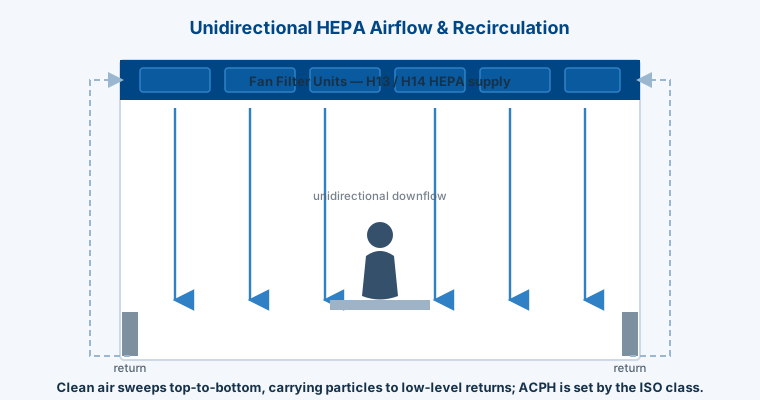
FFUs only perform as well as the ceiling they sit in. Pak Gusu supplies both walkable ceiling systems — which carry maintenance foot traffic above the cleanroom — and T-grid suspended systems, with FFU cut-outs, blank tiles and lighting positions coordinated on a single layout drawing. Because the FFUs, wall and ceiling panels and cleanroom LED lights come from one manufacturer, module dimensions, gasket interfaces and load paths match by design rather than by site improvisation.
This matters at the airtightness level too: every FFU penetration is a potential leak path, and a grid engineered for the unit's flange and seal detail protects the room's pressure cascade. For ISO 5 zones, FFUs can be ganged into continuous banks with tear-drop or flush lighting between rows to preserve unidirectional flow patterns.
How Many FFUs Does Your Cleanroom Need?
The FFU count is driven by the target ISO class, room air change rate (ACPH), ceiling area and heat loads — not by floor area alone. As a first approximation, designers work from typical ceiling coverage ratios:
| ISO class (ISO 14644-1) | Typical air changes per hour | Typical FFU ceiling coverage |
|---|---|---|
| ISO 8 | 10–25 | 5–15% |
| ISO 7 | 30–60 | 15–25% |
| ISO 6 | 90–180 | 25–40% |
| ISO 5 | 240+ / unidirectional | 35–70%, up to full coverage |
From there, the calculation is straightforward: required airflow equals room volume multiplied by the target ACPH, divided by the delivered airflow per unit. Our cleanroom cost calculator includes an ACPH tool that estimates the airflow and FFU count for your room dimensions and class, and our engineers verify the final count against recovery-time and heat-load requirements during design review.
What Controls and Monitoring Options Are Available?
Control options scale with the project. Single rooms often need nothing more than per-unit speed selection; multi-room facilities benefit from centralised control and monitoring.
- Stepped speed control on AC units, set during commissioning and adjusted at the unit.
- Stepless speed control on EC units via 0–10 V or PWM signal.
- Group controllers managing zones of EC FFUs from a single touch panel — useful for setback modes outside production hours.
- BMS integration over Modbus RTU/TCP, exposing per-unit speed, run status and fault alarms.
- Filter monitoring with optional differential-pressure measurement to flag filter loading and plan change-outs.
Speed setback deserves attention in the Gulf, where many facilities run around the clock: reducing FFU speed during non-production periods, within validated limits and with the make-up air balance preserved so the pressure cascade is not disturbed, cuts energy use significantly.
Qualification, Documentation and Delivery to the GCC
Every Pak Gusu FFU is run-tested before despatch, and units ship with EN 1822 filter test certificates, motor and electrical documentation, and installation drawings. The room-side test ports and scan-tested filters are designed to make on-site qualification straightforward — airflow velocity measurement, filter integrity testing and recovery testing per ISO 14644-3 — and we support your IQ/OQ documentation through our cleanroom validation support for the GCC.
FFUs are exported from Lahore on CIF or DAP terms via Jebel Ali (UAE), King Abdulaziz Port Dammam (Saudi Arabia) and Hamad Port (Qatar), packed for sea freight with framed crating to protect filter media. Site installation supervision by our engineers is available at extra cost; full logistics details are covered under shipping and installation in the GCC. To specify FFUs for your project — sizes, motor type, filter grade and controls — request a quote with your room layout and target ISO class, and we will respond with a unit schedule and datasheets.
Related pages
Ready to start your GCC cleanroom project?
Get a free, no-obligation quote — export pricing, lead times and installation across the GCC.
Frequently Asked Questions
Common questions about cleanrooms, standards, cost and how Pak Gusu supplies and installs across the GCC.
Are you a fan filter unit (FFU) supplier and manufacturer in Saudi Arabia, the UAE, Kuwait and the GCC?
Yes. Pak Gusu manufactures fan filter units in Lahore, Pakistan and supplies and exports them to all six GCC countries — Saudi Arabia, the UAE, Qatar, Kuwait, Bahrain and Oman — on CIF or DAP terms via Jebel Ali, Dammam and Hamad ports, with H13/H14 HEPA filters sized to your ceiling grid. We do not have a local Gulf office; installation supervision is available at extra cost. Request a quote for country-specific lead times.
What is a fan filter unit (FFU)?
A fan filter unit is a self-contained module combining a motorised fan and an H13 or H14 HEPA filter in one housing, installed in the cleanroom ceiling grid. It draws air from the plenum above and supplies filtered air into the room at a controlled face velocity, typically 0.3 to 0.45 m/s. FFUs allow cleanliness to be scaled module by module rather than relying solely on a central air handling unit.
What are the standard FFU sizes?
The two standard nominal sizes are 1175 x 575 mm, known as 2x4, and 1175 x 1175 mm, known as 4x4, matching common cleanroom ceiling grid modules. A 4x4 unit typically delivers around 1,300 to 2,000 m3/h depending on the set face velocity, and a 2x4 unit roughly half of that. Both sizes are available with H13 or H14 HEPA filters and AC or EC motors.
What is the difference between AC and EC fan filter units?
AC FFUs use external-rotor induction motors with a few fixed speed steps and suit smaller, fixed-duty installations. EC FFUs use brushless electronically commutated motors that typically consume 30 to 50 percent less energy, offer stepless speed control and can be networked for centralised group control and BMS monitoring. For large grids or facilities running continuously, EC units usually justify themselves through energy savings and easier airflow balancing.
How many FFUs does an ISO 7 cleanroom need?
An ISO 7 room typically requires 30 to 60 air changes per hour, which usually corresponds to FFUs covering about 15 to 25 percent of the ceiling area. The exact count depends on room volume, heat loads and required recovery time, calculated as room volume multiplied by target air changes, divided by the airflow per unit. The ACPH tool in the Pak Gusu cleanroom cost calculator gives a quick first estimate for your room dimensions.
Can the HEPA filter be replaced from inside the cleanroom?
Yes. Pak Gusu FFUs use a room-side replaceable design, so the HEPA filter is removed and refitted from below, inside the cleanroom, without entering the ceiling plenum or disturbing the grid. This shortens maintenance shutdowns and avoids exposing the plenum during change-outs. Each replacement filter is factory scan-tested and supplied with its EN 1822 test certificate.
Do you supply fan filter units to the UAE and Saudi Arabia?
Yes. Pak Gusu exports FFUs from Lahore, Pakistan across the GCC on CIF or DAP terms, shipping via Jebel Ali for the UAE, King Abdulaziz Port Dammam for Saudi Arabia and Hamad Port for Qatar. Units are crated for sea freight and shipped with full test documentation, and installation supervision by our engineers is available at extra cost. Contact us at info@pakgusu.com or +92 321 8073738 to request a quotation.
Cleanrooms supplied & installed across the GCC
Manufactured in Pakistan with GUSU (China) technology · shipped to Jebel Ali, Dammam & Hamad (CIF/DAP) · installation available across the Gulf.