
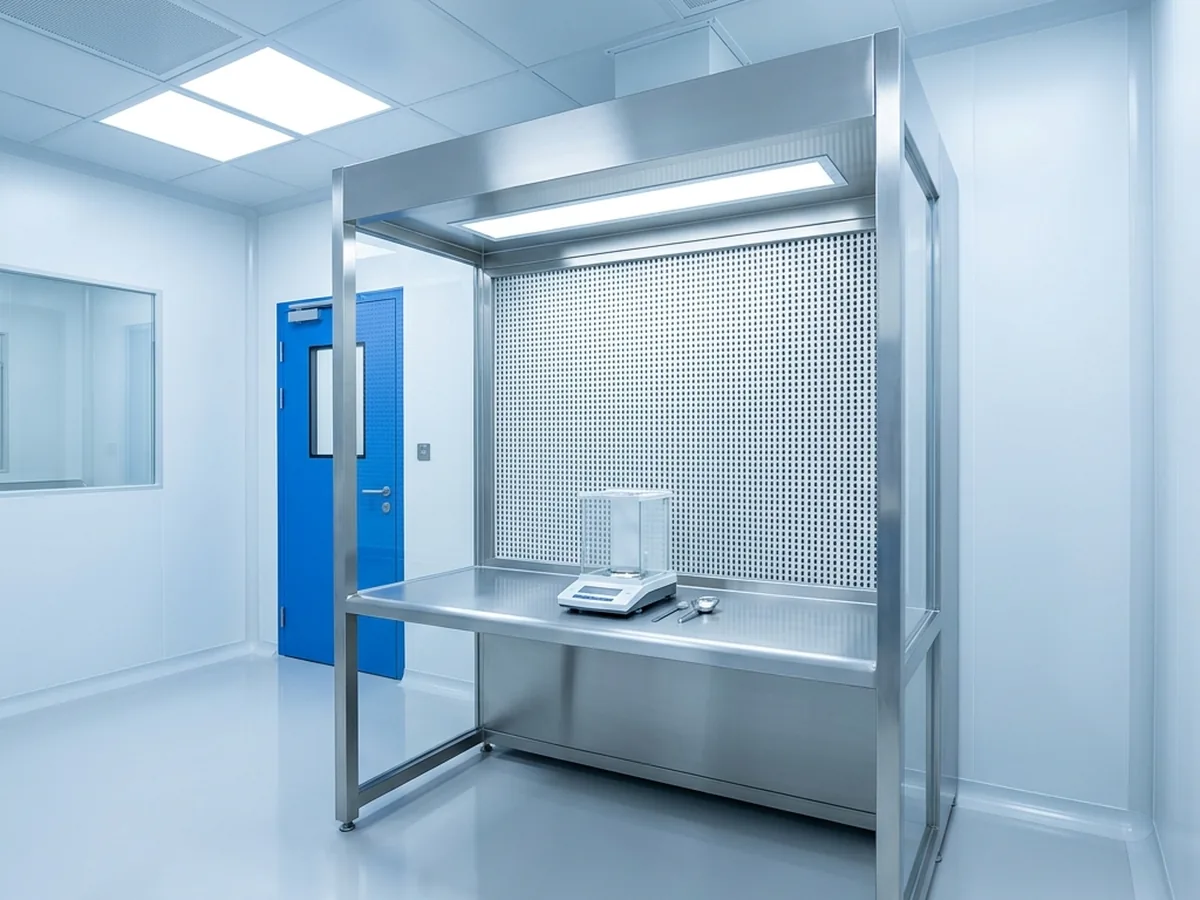
A dispensing booth — also called a sampling booth, weighing booth or reverse laminar air flow (RLAF) booth — is a self-contained downflow enclosure that protects the operator and the product while open powders are weighed, dispensed, sub-divided or sampled. Filtered air is delivered vertically over the work zone and drawn away through low-level return grilles, sweeping airborne dust out of the operator's breathing zone instead of pushing it toward it.
Pak Gusu builds these booths in Lahore, Pakistan as the technical partner of GUSU Purification (China), with stainless-steel work zones, three-stage filtration terminating in HEPA H13/H14, and airflow monitoring as standard. They are designed to deliver ISO 14644-1 Class 5 air at the work zone and to integrate cleanly with the surrounding GMP suite.
We frame containment honestly. A booth reduces operator exposure for open handling, but the actual exposure level for your specific compound must be confirmed by SMEPAC-style measurement on site — we make no blanket certification or potency claims, only deliver hardware that is built and documented to be verified.
Key takeaways
- A dispensing/sampling/weighing booth is a reverse laminar air flow (RLAF) downflow booth that protects both the operator and the product during open powder handling.
- Vertical HEPA-filtered downflow at roughly 0.45 m/s with a low-level return sweeps airborne dust away from the breathing zone; typical builds recirculate about 90% of the air and exhaust about 10%.
- Three-stage filtration (G4 pre-filter, F8/F9 secondary, terminal HEPA H13/H14) delivers air designed to meet ISO 14644-1 Class 5 at the work zone.
- SS304 work zones (SS316L optional), coved corners and a perforated rear return wall make the booth cleanable and validation-ready (DQ/IQ/OQ/PQ).
- Containment is framed honestly: booths suit lower-hazard compounds, and real operator exposure must be verified by SMEPAC-style testing — no certification claims.
- Manufactured in Pakistan and exported across the GCC on CIF/DAP terms; installation or supervision is available at extra cost.
What is a dispensing or sampling booth?
A dispensing or sampling booth is a partial-enclosure clean-air device used wherever open powders, granules, active pharmaceutical ingredients (APIs) or excipients are handled outside a closed process. The same equipment is marketed under several names — dispensing booth, weighing booth, sampling booth and reverse laminar air flow booth — because the airflow principle is identical even when the task differs.
The key distinction is who the booth protects. A conventional horizontal laminar-flow bench blows clean air toward the operator and only protects the product. A reverse (downflow) booth is engineered the other way round: clean air descends over the work zone and is captured low at the rear, so it protects the product and reduces the dust the operator breathes. That dual protection is why booths are the default for raw-material dispensaries and QC sampling rooms.
Typical tasks carried out inside a booth include weighing and dispensing of batch components, sub-division of bulk drums, charging of vessels, and QC sampling of incoming materials in the warehouse.
How does a reverse laminar air flow booth work?
Air is drawn into a fan plenum at the top of the booth, pushed through the filter bank, and delivered as a vertical, unidirectional downflow across the operator's work surface. As it descends it carries airborne particulate down and back into low-level return grilles in the rear (and sometimes side) walls, away from the breathing zone. A proportion of the captured air is re-filtered and recirculated; the balance is exhausted to keep heat, fines and the room pressure in check.
- Downflow velocity: approximately 0.45 m/s nominal (commonly within 0.36–0.54 m/s), giving stable unidirectional flow over the work zone.
- Three-stage filtration: a G4 pre-filter for coarse dust, an F8/F9 secondary filter, then a terminal HEPA H13/H14 filter at the supply face.
- Air balance: typically about 90% recirculated and 10% exhausted, with a 100%-recirculation option where room balance allows.
- Monitoring: differential-pressure gauges across the HEPA plus a low-airflow alarm so operators know the booth is performing.
If a term here is unfamiliar, our cleanroom glossary defines HEPA grades, MPPS, ISO classes and unidirectional flow in plain language.
Dispensing and sampling booth specifications
The figures below are typical for our standard RLAF booths. Sizes, exhaust ratio and material grade are configured to your SOPs, room layout and the products you handle.
| Parameter | Typical specification |
|---|---|
| Booth type | Reverse laminar air flow (RLAF) downflow containment booth |
| Airflow pattern | Vertical unidirectional downflow with low-level rear return |
| Downflow velocity | ~0.45 m/s nominal (typically 0.36–0.54 m/s) |
| Filtration | 3-stage: G4 pre-filter + F8/F9 secondary + terminal HEPA H13/H14 |
| HEPA efficiency | H13 ≥99.95% / H14 ≥99.995% at MPPS (EN 1822) |
| Air balance | ~90% recirculated / ~10% exhaust (configurable; 100% recirculation optional) |
| Work-zone cleanliness | Designed to meet ISO 14644-1 Class 5 (at rest) |
| Work-zone construction | SS304 (SS316L optional); coved internal corners |
| Filter monitoring | Magnehelic / digital DP gauges + low-airflow audible-visual alarm |
| Lighting | LED, 300–500 lux |
| Noise level | Typically < 70 dB(A) |
| Configurations | Single- or multi-operator; custom widths to suit your process |
We do not publish a fixed datasheet PDF or pricing here — for a project-specific specification, request a quote and our engineers will size the booth to your batch and containment needs.
Where are weighing, sampling and dispensing booths used?
Booths are deployed wherever open powder handling needs both product cleanliness and operator protection. The most common settings are:
- Pharmaceutical dispensaries — weighing and dispensing of APIs and excipients into batch containers, a core step in solid-dose and sterile manufacturing. See our pharmaceutical and nutraceutical cleanrooms page.
- Warehouse QC sampling — sampling of incoming raw materials and packaging components under HEPA-filtered air, keeping the warehouse sampling area controlled without a full cleanroom.
- Nutraceutical, food and beverage powders — blending pre-weighs, flavour and additive dispensing and similar dusty tasks; relevant to food and beverage manufacturers.
- Cosmetics and fine chemicals — pigment and powder dispensing where both cross-contamination and operator dust exposure matter.
Because the booth is a localised device, it is often the most practical, space-efficient way to add controlled handling to an existing room — you can compare configurations with the cleanroom cost calculator.
How is containment measured — OEB, OEL and SMEPAC-style testing?
Containment is the booth's ability to keep operator exposure below a target. That target is usually expressed as an Occupational Exposure Limit (OEL), the 8-hour time-weighted airborne concentration a worker may be exposed to, and grouped into Occupational Exposure Bands (OEB) from low hazard (OEB 1) to highly potent (OEB 5). We do not claim a fixed OEL for our booths because the real result depends on your compound, technique and air balance — it has to be measured.
The recognised method is SMEPAC-style testing (the ISPE good-practice approach to Standardised Measurement of Equipment Particulate Airborne Concentration), which uses a surrogate powder and breathing-zone sampling to quantify exposure during representative tasks. We build the booth to be testable and support that exercise; we do not issue containment certifications.
| Containment need | Typical approach |
|---|---|
| Low hazard (OEB 1–2) | Open RLAF downflow dispensing booth |
| Moderate hazard (OEB 3) | RLAF booth with increased exhaust, confirmed by site testing |
| High potency (OEB 4–5) | Closed isolator / containment system — an open booth is not appropriate alone |
These bands are indicative only. Always select equipment from your compound's safety data and verify the chosen booth by SMEPAC-style measurement before routine use.
Construction, materials and cleanability
The wetted work zone is built in SS304 stainless steel as standard, with SS316L available for more aggressive products or wash-down regimes. Internal corners are coved and welds are ground and polished so there are no flat ledges or sharp angles to trap powder, which keeps cleaning fast and reproducible.
- Perforated rear return wall for even low-level capture across the work surface.
- Smooth, crevice-free internal finish that withstands routine wipe-down and validated cleaning agents.
- HEPA filters in a gel-seal or clamp housing for in-situ integrity testing and tool-free changeout.
- DP gauges and a low-airflow alarm mounted in the operator's eyeline.
- Options: light curtains/safety sensors, IP-rated controls, castors or floor-fix frames, and integrated weigh-scale cut-outs.
The same stainless detailing carries through our wider hardware range, so a booth sits naturally alongside our cleanroom wall panels and pass-through chambers.
Qualification and integration with your cleanroom
Every booth is delivered validation-ready. We provide the documentation set to support a standard DQ / IQ / OQ / PQ lifecycle and design the unit so the following acceptance tests can be performed and passed on site:
- HEPA filter integrity (DOP/PAO) test at the installed face.
- Downflow velocity mapping across the work zone.
- Airborne particle count to ISO 14644-1 (at rest / in operation).
- Recovery and airflow-visualisation (smoke) studies.
- SMEPAC-style containment verification where required.
A booth rarely stands alone — it usually sits inside a dispensing suite served by airlocks, pass boxes and a balanced HVAC scheme. We can supply the booth as a component or as part of a turnkey room. For the broader programme, see cleanroom validation across the GCC, and note that any regulatory submission framing is honest: we design to meet the relevant standard and support your submission rather than claiming approvals on your behalf.
Delivery and installation across the GCC
Pak Gusu manufactures in Lahore and exports weighing, sampling and dispensing booths across the GCC — the UAE, Saudi Arabia, Qatar, Kuwait, Bahrain and Oman — on CIF or DAP terms through Jebel Ali (UAE), King Abdulaziz Port Dammam (KSA) and Hamad Port (Qatar). Booths are crated for sea freight and arrive ready for positioning and final connection.
We do not operate a Gulf office, so on-site installation or installation supervision is available at extra cost and quoted per project. Logistics, lead times and Incoterms are explained on our shipping and installation page.
Ready to specify a booth? Request a quote with your products, batch sizes and ISO target, and our engineers will return a project-specific configuration and delivery plan.
Related pages
Ready to start your GCC cleanroom project?
Get a free, no-obligation quote — export pricing, lead times and installation across the GCC.
Frequently Asked Questions
Common questions about cleanrooms, standards, cost and how Pak Gusu supplies and installs across the GCC.
Do you supply weighing and sampling booths in Saudi Arabia, the UAE and the GCC?
Yes. Pak Gusu manufactures weighing, sampling and dispensing booths in Lahore, Pakistan and supplies them to all six GCC countries — Saudi Arabia, the UAE, Qatar, Kuwait, Bahrain and Oman — on CIF or DAP terms via Jebel Ali, Dammam and Hamad ports, with HEPA downflow and containment options for your dispensary. Installation supervision is available at extra cost.
What is the difference between a dispensing booth and a sampling booth?
They are the same type of reverse laminar air flow (RLAF) downflow booth; the name simply reflects the task. A dispensing or weighing booth is used to weigh and dispense batch components, while a sampling booth is typically used in the warehouse to sample incoming raw materials. Both protect the operator and the product with vertical HEPA-filtered downflow and a low-level return.
What is a reverse laminar air flow booth?
A reverse laminar air flow (RLAF) booth delivers clean air vertically downward over the work zone and captures it at low-level rear grilles, so contaminated air moves away from the operator rather than toward them. This is the reverse of a standard laminar bench, which blows air toward the operator and protects only the product. The result is simultaneous product and operator protection during open powder handling.
What downflow velocity and filtration does a dispensing booth use?
A typical booth runs a nominal downflow velocity of about 0.45 m/s (commonly 0.36–0.54 m/s) for stable unidirectional flow. Filtration is three-stage: a G4 pre-filter, an F8/F9 secondary filter and a terminal HEPA H13/H14 filter rated 99.95%–99.995% at MPPS. Most builds recirculate around 90% of the air and exhaust roughly 10%.
Can a weighing booth handle highly potent (OEB 4–5) compounds?
An open booth is generally suited to lower-hazard materials, typically OEB 1–3, and is not appropriate on its own for highly potent OEB 4–5 compounds, which usually require a closed isolator. The actual exposure for your specific product must be confirmed by SMEPAC-style measurement on site. Pak Gusu builds the booth to be testable but does not issue containment certifications or potency claims.
Does Pak Gusu deliver and install booths in the Gulf?
Yes. Booths are manufactured in Lahore and exported across the GCC on CIF or DAP terms through Jebel Ali, Dammam and Hamad ports. Pak Gusu has no Gulf office, so on-site installation or supervision is available at extra cost and quoted per project. Request a quote with your batch sizes and ISO target for a configuration and delivery plan.
Cleanrooms supplied & installed across the GCC
Manufactured in Pakistan with GUSU (China) technology · shipped to Jebel Ali, Dammam & Hamad (CIF/DAP) · installation available across the Gulf.