
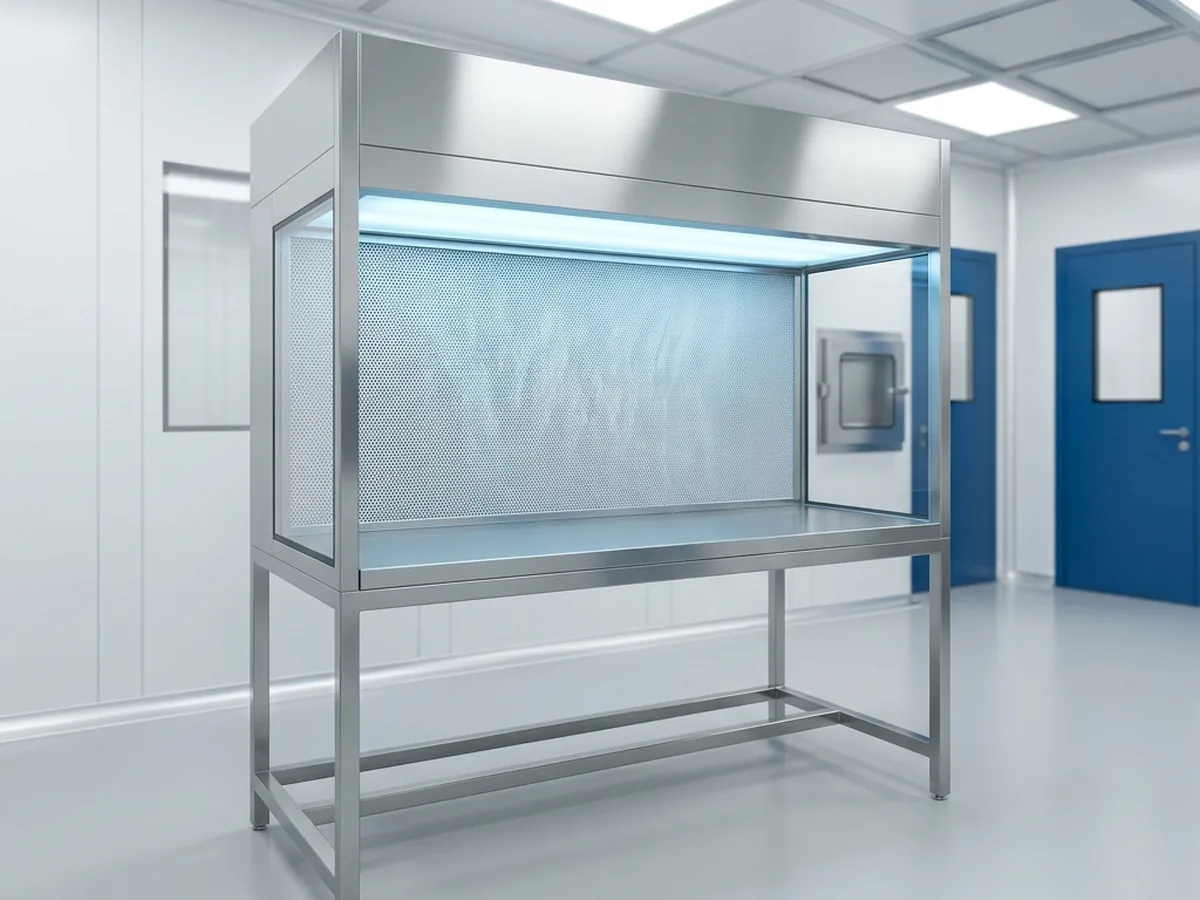
LAF units - laminar air flow units - are HEPA-filtered enclosures that deliver a unidirectional sheet of clean air across a work zone, typically at about 0.45 m/s (±20%), to create conditions designed to meet ISO 14644-1 Class 5 / EU-GMP Grade A exactly where product is exposed. They are used to protect open product during sterile filling, dispensing, media plating, sterility testing and device assembly - a LAF protects the product, not the operator, so it is not a substitute for a biological safety cabinet or a containment enclosure when handling hazardous material.
Pak Gusu Technology manufactures and exports LAF units from Lahore, Pakistan - vertical and horizontal benches, mobile trolley units and ceiling-mounted modules - to the six GCC states and across Pakistan. Units are built with H13/H14 HEPA filtration, are designed to meet ISO 14644 and EU-GMP, and are supplied with IQ/OQ/PQ documentation to support your validation. For full-ceiling coverage see fan filter units, for enclosed powder handling see weighing and sampling booths, or request a quote for your target grade.
A laminar air flow (LAF) unit is a HEPA-filtered enclosure that delivers a single-direction (unidirectional) sheet of ultra-clean air across a work zone, creating an ISO 14644-1 Class 5 / EU-GMP Grade A environment exactly where the product is exposed. The filtered air moves at a controlled, near-uniform velocity of roughly 0.45 m/s (±20%), so the first air reaching the product is the cleanest in the room and sweeps particles away before they can settle.
Pak Gusu Technology builds vertical and horizontal LAF benches, ceiling-mounted fan-filter modules, mobile trolleys and walk-in LAF booths, all engineered around H13/H14 HEPA filtration and supplied validation-ready for export across the GCC. Whether you need an ISO 5 island over a filling line in the UAE or a sterility-testing bench for a QC lab in Saudi Arabia, the unit is built to suit your room grade and process.
To scope a unit for your facility, request a quote with your format, size and target grade — we will confirm an exact specification and lead time.
Key takeaways
- A LAF unit delivers unidirectional, HEPA-filtered first air at roughly 0.45 m/s (±20%), giving ISO 5 / EU-GMP Grade A protection right over the exposed product.
- Vertical downflow protects the product from operator-shed particles; horizontal crossflow suits bench assembly and inspection but blows toward the operator — never use it for hazardous materials.
- Formats include tabletop and floor benches, ceiling FFU modules and garment cabinets, mobile trolleys, and walk-in booths over filling lines.
- Filtration is a washable G4 pre-filter plus H13/H14 HEPA, with EC-fan, magnehelic/DP gauge and digital alarm options.
- Every unit ships validation-ready, with built-in ports for DOP/PAO filter-integrity testing plus velocity and smoke-pattern studies.
- A LAF unit protects the product, not the operator — for cytotoxic, sensitising or microbiological hazards specify a biosafety cabinet or isolator instead.
What is a laminar air flow unit?
A laminar air flow unit replaces the random, mixed (turbulent) air of an ordinary room with a smooth, parallel sheet of HEPA-filtered air that travels in one direction at a uniform speed. Because the air does not swirl, particles are not re-circulated over the product — they are carried straight off the work zone and away. This is the engineering basis of the first-air principle in EU-GMP Annex 1: the air that first contacts an exposed product or sterile surface must be the cleanest, unobstructed by hands, tools or components placed upstream.
To stay laminar, the airstream is held at a controlled velocity. EU-GMP Annex 1 gives a guidance value of 0.36–0.54 m/s at the working position (commonly cited as 0.45 m/s ±20%) for unidirectional Grade A airflow. Combined with H13 or H14 HEPA filtration, this produces an ISO 14644-1 Class 5 / EU-GMP Grade A condition at the point of use, even when the surrounding room is classified to a lower grade.
Vertical vs horizontal laminar flow: which should you choose?
Both types deliver the same ISO 5 first air; the difference is the direction the clean air travels and therefore what it protects. Vertical LAF pushes filtered air downward from a ceiling filter onto the work surface, while horizontal LAF pushes it forward from a rear filter wall toward the operator.
| Aspect | Vertical LAF (downflow) | Horizontal LAF (crossflow) |
|---|---|---|
| Airflow direction | Top-down from an overhead filter; air exits through the work-surface grille | Back-to-front from a filter behind the work zone; air flows toward the operator |
| Best suited to | Working over an exposed product — filling, dispensing, weighing, plate pouring, sterile compounding | Bench assembly and inspection of sealed items, electronics and device work, sterility testing |
| Product protection | Excellent — operator-shed particles are swept down and away from the product | Good, but anything the first air crosses (hands, fixtures) can shadow the product downstream |
| Operator exposure | Lower — air moves away from the breathing zone | Air blows toward the operator; not suitable for powders, sensitising or hazardous materials |
| Footprint | Needs overhead filter plenum and height; shallower bench depth | Needs depth behind the work zone; lower overall height |
| Disturbance sensitivity | Downflow can be disrupted by tall objects standing on the bench | Long, unobstructed first-air path along the work surface |
Neither a vertical nor a horizontal LAF unit protects the operator from the product. For cytotoxic, sensitising or microbiological hazards, specify a biosafety cabinet or isolator instead — we are happy to advise on the right enclosure for your process.
What formats of LAF unit can you supply?
We build laminar flow in whatever format suits the process and the room it sits in:
- LAF bench / laminar flow cabinet — tabletop or floor-standing, vertical or horizontal, for a single workstation such as media filling, sterility testing or aseptic dispensing.
- Ceiling-mounted LAF modules — fan-filter units (FFUs) integrated into the cleanroom ceiling to create a Grade A canopy over a critical zone, or as garment-storage and gowning cabinets that keep clean clothing protected.
- Mobile LAF trolley — a wheeled, self-contained unidirectional-flow cart that provides temporary ISO 5 cover where it is needed and can be moved between rooms.
- LAF booth / curtain booth — a walk-in unidirectional-flow enclosure (often with PVC strip curtains) placed over a filling line, sampling point or dispensary to give operators a Grade A working envelope.
- Dispensing / down-flow booths — for open powder handling where both product and operator protection matter, configured with appropriate capture airflow.
Where are laminar air flow units used?
Laminar flow units are specified anywhere an exposed product needs ISO 5 / Grade A air without classifying the whole room to that level. Typical uses include:
- Pharmaceutical and nutraceutical aseptic dispensing, sterile compounding, media fills and vial/ampoule handling.
- Sterility testing, microbiology plate pouring and environmental-monitoring sample handling in QC laboratories.
- Medical-device assembly, optics and microelectronics work where particle deposition must be minimised.
- Hospital and healthcare applications such as IV/TPN admixture and pharmacy aseptic units.
- Food, beverage and cosmetics filling points where open product is briefly exposed to the environment.
How is a LAF unit built and filtered?
Each unit pairs a robust enclosure with a two- or three-stage filtration train. Room air is first drawn through a washable G4 / ISO Coarse pre-filter that captures large debris and protects the HEPA, then through the terminal HEPA filter that produces the clean unidirectional sheet. An optional F7/F8 intermediate filter extends HEPA life in dustier environments.
- HEPA filtration: H13 (≥99.95% at MPPS) as standard, H14 (≥99.995%) optional, tested to EN 1822.
- Fan: AC centrifugal blower standard; energy-efficient EC (brushless) fan optional, with speed control to hold velocity as the HEPA loads.
- Monitoring: a magnehelic / differential-pressure gauge across the HEPA shows filter loading at a glance; a digital airflow or velocity alarm is optional.
- Construction: powder-coated steel or SS 304 body with an SS 304 work surface (SS 316 option) and clear tempered-glass or acrylic side panels and front sash.
- Lighting: integrated cleanroom LED lighting for a bright, shadow-free work surface.
- Integration: designed to work alongside our pass-through chambers and cleanroom partitions for a complete aseptic workflow.
Technical specifications and typical options
The figures below are typical, configurable options. Final velocity, filter grade, body material and size are built to suit your room grade and process — share your requirement and we will confirm an exact specification.
| Airflow pattern | Unidirectional (laminar) — vertical downflow or horizontal crossflow |
| Average air velocity | ~0.45 m/s, adjustable within the 0.36–0.54 m/s band at the working level |
| Cleanliness at work zone | Designed to meet ISO 14644-1 Class 5 / EU-GMP Grade A (as configured) |
| HEPA filter | H13 (≥99.95%) standard; H14 (≥99.995%) option, tested to EN 1822 at MPPS |
| Pre-filtration | Washable G4 / ISO Coarse pre-filter; optional F7/F8 intermediate filter |
| Fan | AC centrifugal standard; EC brushless option with velocity control |
| Body / work surface | Powder-coated steel or SS 304; SS 304 work top (SS 316 option) |
| Viewing panels / sash | Tempered safety glass or clear acrylic |
| Monitoring | Magnehelic / DP gauge across HEPA; optional digital airflow alarm |
| Lighting | LED, typically ≥ 800 lux at the work surface |
| Noise level | Typically < 65 dBA at standard velocity (size dependent) |
| Electrical | 220–240 V / 50 Hz single phase typical; international-standard components on request |
| Formats | Bench (tabletop/floor), ceiling FFU module, mobile trolley, walk-in booth, garment cabinet |
| Typical sizes | Working widths approx. 600–1800 mm; custom and multi-bay units built to order |
| Validation ports | Upstream aerosol injection and downstream scan ports for DOP/PAO integrity testing |
How is a LAF unit qualified and validated?
We supply every LAF unit validation-ready, with the test points and documentation your qualification team needs. The unit ships with built-in aerosol injection and scan ports so the installed HEPA can be challenged in place.
- Filter integrity (DOP/PAO): the installed HEPA and its seal are scanned with a PAO/DOP aerosol to confirm there is no leak above the ISO 14644-3 acceptance limit.
- Airflow velocity & uniformity: velocity is mapped across the filter face to confirm the 0.45 m/s ±20% unidirectional profile.
- Airflow visualisation (smoke study): a smoke / airflow-pattern test demonstrates a true unidirectional sweep and first-air protection of the product.
- Particle counts: at-rest and in-operation counts confirm the ISO 5 / Grade A condition at the work zone.
We can align this with your wider cleanroom validation programme (IQ/OQ/PQ) so the LAF qualification dovetails with the room it serves. We support your submission to the relevant regulator with the test data and certificates.
How do you supply LAF units across the GCC?
Pak Gusu manufactures in Lahore, Pakistan as the technical partner of GUSU Purification (China) and exports LAF units across the GCC — the UAE, Saudi Arabia, Qatar, Kuwait, Bahrain and Oman — on CIF or DAP terms through Jebel Ali, King Abdulaziz Port (Dammam) and Hamad ports. We do not operate a Gulf office; on-site installation or supervision is available at additional cost.
To plan a project, request a quote with your format, size and room grade, or use the cleanroom cost calculator for an indicative budget. See shipping & installation for lead times and Incoterms, or our GCC cleanroom overview for regional delivery details.
Related pages
Ready to start your GCC cleanroom project?
Get a free, no-obligation quote — export pricing, lead times and installation across the GCC.
Frequently Asked Questions
Common questions about cleanrooms, standards, cost and how Pak Gusu supplies and installs across the GCC.
What is the airflow velocity of a laminar air flow unit?
A LAF unit holds a controlled, near-uniform velocity so the air stays unidirectional. EU-GMP Annex 1 gives a guidance value of 0.36–0.54 m/s at the working position, commonly described as 0.45 m/s ±20%. We map and set this velocity during qualification and can adjust it within that band to suit your process.
What is the difference between vertical and horizontal laminar flow?
Vertical LAF pushes filtered air downward from a ceiling filter onto the work surface, which is ideal when you work over an exposed product such as filling or dispensing. Horizontal LAF pushes air forward from a rear filter toward the operator, suiting bench assembly and sterility testing of sealed items. Horizontal flow should not be used for powders, sensitising or hazardous materials because the air moves toward the operator.
Does a LAF unit protect the operator as well as the product?
No. A laminar air flow unit is designed to protect the product by bathing it in clean first air; it does not contain or capture anything hazardous coming off the product. For cytotoxic, sensitising or microbiological hazards you need a biosafety cabinet or an isolator instead. We can advise on the correct enclosure for your application.
Which HEPA filter grade do your LAF units use?
We fit H13 HEPA (≥99.95% efficiency at the most penetrating particle size) as standard and offer H14 (≥99.995%) as an option, both tested to EN 1822. A washable G4 pre-filter protects the HEPA, with an optional F7/F8 intermediate filter to extend its life in dustier environments. This combination delivers ISO 14644-1 Class 5 / EU-GMP Grade A air at the work zone.
Are your laminar flow units validation-ready?
Yes. Every unit is built with aerosol injection and downstream scan ports so the HEPA can be integrity-tested (DOP/PAO) in place, and we support velocity mapping, smoke-pattern studies and particle counts. We provide the test data and certificates so the unit can be qualified as part of your IQ/OQ/PQ and your submission to the relevant regulator. Installation or supervision can be arranged at additional cost across the GCC.
Are you a laminar air flow unit supplier and manufacturer in Saudi Arabia, Kuwait, Oman and Bahrain?
Yes. Pak Gusu is a laminar air flow (LAF) unit manufacturer based in Lahore, Pakistan, and we supply and export LAF benches, booths and trolleys to all six GCC countries — Saudi Arabia, the UAE, Qatar, Kuwait, Bahrain and Oman — on CIF or DAP terms via Jebel Ali, Dammam and Hamad ports. We do not have a local Gulf office; on-site installation and supervision can be arranged at extra cost. Request a quote with your format and room grade for country-specific lead times.
Can you ship a LAF unit to the UAE, Saudi Arabia or Qatar?
Yes. We export LAF benches, booths, trolleys and ceiling modules across the GCC on CIF or DAP terms through Jebel Ali, King Abdulaziz Port (Dammam) and Hamad ports. We do not have a Gulf office, but installation and supervision are available at extra cost. Request a quote or use our cost calculator for an indicative budget and lead time.
Cleanrooms supplied & installed across the GCC
Manufactured in Pakistan with GUSU (China) technology · shipped to Jebel Ali, Dammam & Hamad (CIF/DAP) · installation available across the Gulf.