
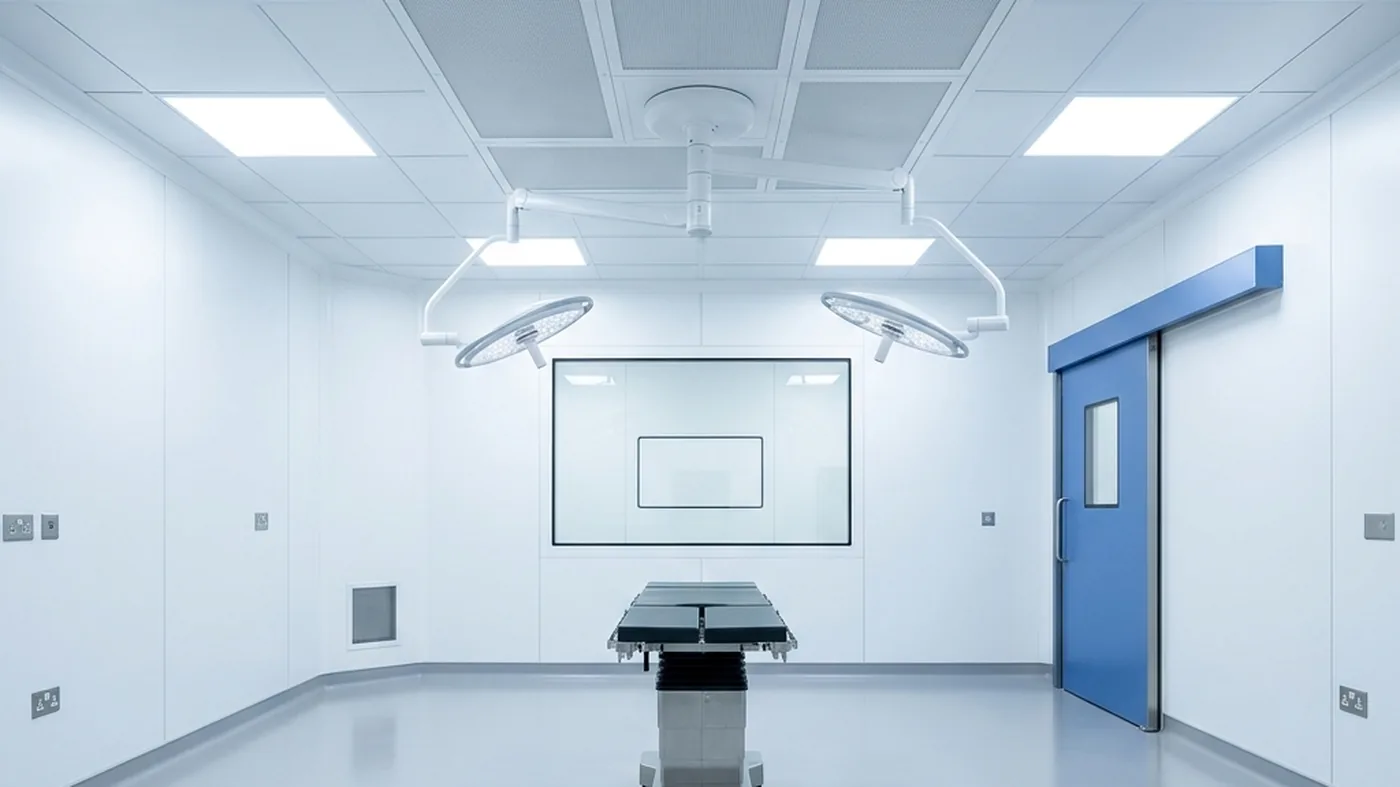
A modular operation theatre (modular OT) is a prefabricated operating room system: hermetically sealed wall and ceiling panels, airtight sliding doors and a HEPA-filtered air supply that together create an aseptic surgical environment inside a hospital's structural shell. Because the components are factory-made and assembled dry on site, a modular OT is typically completed in weeks rather than the months a blockwork-and-tile theatre demands.
Pak Gusu Technology (Pvt.) Ltd. manufactures complete modular OT systems in Lahore, Pakistan, as the technical partner of GUSU Purification (China), and exports them across the GCC — the UAE, Saudi Arabia, Qatar, Kuwait, Bahrain and Oman — on CIF or DAP terms, with installation supervision available at additional cost. This page explains what the system includes, the ventilation guidance it is designed to meet, the theatre types we supply and how a Gulf hospital project runs from drawing to handover.
Key takeaways
- A modular OT is a factory-built hermetic wall, ceiling and door system that creates a positive-pressure aseptic surgical environment inside the hospital shell.
- Core elements: antibacterial steel or HPL wall panels, hermetic sliding doors, a laminar or plenum ceiling over the table, peripheral return air and a surgeon control panel.
- Designed to meet recognised OT ventilation guidance — roughly 20–25 air changes per hour for conventional theatres, or an ultra-clean laminar canopy for implant surgery — with documentation to support your regulator submission.
- Three configurations: general surgery OT, ultra-clean orthopaedic OT and a hybrid-ready shell for imaging-integrated theatres.
- Manufactured in Lahore and shipped CIF/DAP via Jebel Ali, Dammam or Hamad; IPS/UPS and medical gas remain with your specialist contractors.
- No prices are published online — request a quote or use the cost calculator for indicative budgeting.
What Is a Modular Operation Theatre?
A modular operation theatre is supplied as a kit of factory-engineered components: hermetic wall and ceiling panels, airtight doors, a laminar or plenum air-supply ceiling, return-air columns and a surgeon control panel. The panels lock together inside the hospital's structural shell to form a sealed, flush, joint-minimised envelope that can hold a stable positive-pressure cascade and withstand daily chemical disinfection — the two things plastered and tiled rooms struggle to do over time.
Pak Gusu manufactures the architectural envelope and airflow components. The isolated power supply (IPS/UPS), medical gas pipeline, pendants and surgical lights are normally provided by the hospital's specialist contractors; we coordinate cut-outs, back-boxes and ceiling loadings at design stage so every service lands in the right place during assembly.
What Are the Key Elements of a Modular OT?
Every Pak Gusu modular OT is configured from the same core set of building blocks:
- Wall system — antibacterial powder-coated steel, stainless steel or HPL cleanroom panels with coved floor and ceiling junctions, flush glazing and concealed fixings; lead lining can be added behind panels where radiation shielding is specified.
- Hermetic sliding doors — automatic airtight cleanroom doors with compression sealing, vision panels, sensor and elbow-switch operation, and interlocking with preparation and disposal rooms where the layout requires it.
- Ceiling and air supply — a sealed plenum or laminar ceiling over the operating table with H13/H14 terminal HEPA filtration (EN 1822) and flush, sealed LED lighting.
- Peripheral return air — low-level return columns in the room corners that draw air outwards and downwards across the theatre, sweeping particles away from the table.
- Pressure cascade — the theatre held positive to anaesthesia, scrub and corridor zones, with differential-pressure monitoring at the control panel; where a sterile preparation (lay-up) room is specified, it is normally held slightly positive to the theatre itself.
- Surgeon control panel — temperature, humidity and pressure display, theatre and elapsed-time clocks, lighting control, medical-gas alarm interface and optional intercom.
- Scrub and utility integration — scrub troughs, storage and writing units, X-ray/PACS viewing provision and pass-through chambers for sterile instrument transfer.
- Power provision — IPS/UPS isolated power for Group 2 medical locations (IEC 60364-7-710) is supplied by your electrical contractor; we provide coordinated openings and supports.
Which Standards and Ventilation Rates Apply?
There is no single global operating theatre standard; most Gulf hospital specifications draw on recognised international guidance for OT ventilation together with ISO 14644 for particle cleanliness. Our theatres are designed to meet that guidance — final compliance is always assessed by your hospital's regulator, and we support your submission with drawings, airflow schedules and commissioning test documentation. See our cleanroom validation services for the GCC for the testing side.
| Design parameter | Conventional modular OT | Ultra-clean (laminar) OT |
|---|---|---|
| Air supply concept | Approx. 20–25 air changes per hour of HEPA-filtered air | Unidirectional downflow canopy over the table, typically 0.25–0.38 m/s |
| Terminal filtration | HEPA H13/H14 (EN 1822) | HEPA H14 across the canopy face |
| Cleanliness design target (at rest) | ISO 14644-1 Class 7 | ISO Class 5 beneath the canopy |
| Room pressure | Positive, typically +15 to +25 Pa to adjacent rooms | Positive, typically +15 to +25 Pa to adjacent rooms |
| Temperature and humidity | 20–24 °C, RH commonly 40–60% | 20–24 °C, RH commonly 40–60% |
| Typical procedures | General surgery, obstetrics, ENT, emergency | Joint replacement, spinal, neuro and other implant surgery |
Which Types of Modular OT Do We Supply?
We supply three standard configurations, each adaptable to your architect's room sizes and surgical case mix:
- General modular OT — conventional turbulent-dilution ventilation at roughly 20–25 ACH for general surgery, obstetrics, ENT and emergency theatres.
- Ultra-clean orthopaedic OT — a laminar flow canopy with H14 terminal filtration over the table, designed for ISO Class 5 conditions at the wound site during joint replacement and other implant procedures.
- Hybrid-ready shell — a larger-footprint envelope with reinforced ceiling support, radiation-shielding provision and additional service routes, prepared for hospitals that will integrate intra-operative imaging now or in a later phase.
Modular vs Conventional Operating Theatre Construction
The construction method is the main decision a hospital planner makes before tendering an operating theatre, because it drives programme, hygiene performance and lifetime flexibility:
| Aspect | Conventional (blockwork) OT | Modular OT |
|---|---|---|
| Structure | Block, plaster and tiles built wet on site | Factory-made steel or HPL panels assembled dry |
| On-site programme | Months of wet trades plus drying time | Weeks of dry assembly once the shell is ready |
| Airtightness | Difficult to seal; pressure drifts as finishes crack | Gasketed hermetic joints hold the pressure cascade |
| Hygiene | Grout lines and sharp corners trap contamination | Flush, coved, antibacterial surfaces; fast disinfection |
| Services integration | Chased into walls; rework is destructive | Pre-cut openings and accessible service voids |
| Future changes | Demolition and dust inside a live hospital | Panels demount and reconfigure with minimal disruption |
| Quality control | Depends on site workmanship | Factory tolerances and pre-shipment inspection |
Modular construction is particularly suited to live hospitals in the Gulf, where surgical capacity cannot be taken offline for a long wet-trades programme.
How Does a Modular OT Project Run for a Gulf Hospital?
A Gulf hospital project typically follows the same six steps, whether it is a single theatre or a full surgical suite within a wider healthcare and hospitals project:
- Design and layout. We work from your architect's drawings to fix theatre sizes, door positions, pressure zoning and ceiling layouts, and issue coordination drawings for the IPS, medical gas and imaging contractors.
- Fabrication in Lahore. Panels, doors, ceilings and control panels are manufactured to the approved drawings using GUSU Purification tooling and processes.
- Pre-shipment inspection. Components are checked, labelled by room and packed for sea freight; you are welcome to inspect at the factory or appoint a third-party inspector.
- Shipping on CIF or DAP terms. Consignments sail to Jebel Ali (UAE), King Abdulaziz Port Dammam (Saudi Arabia) or Hamad Port (Qatar) — see shipping and installation across the GCC.
- Installation. Your fit-out contractor assembles the system to our drawings, or we provide installation supervision or a complete installation team at additional cost.
- Commissioning support. Airflow, pressure, filter-integrity and particle-count documentation to support handover and your regulatory file.
How Much Does a Modular Operation Theatre Cost?
We do not publish prices for modular operation theatres. Pricing depends on theatre size, the ventilation concept (conventional or ultra-clean), the number of hermetic doors, control-panel specification, radiation-shielding requirements and whether installation support is included — so a meaningful figure can only follow a defined scope. As a strict company policy, indicative figures appear only on our cleanroom cost calculator.
For a firm budget, request a quote with your theatre count, room sizes and surgical specialties, or send drawings to info@pakgusu.com or WhatsApp +92 321 8073738. We respond with a defined scope, delivery terms to your nearest Gulf port and a line-item offer your procurement team can compare.
Related pages
Ready to start your GCC cleanroom project?
Get a free, no-obligation quote — export pricing, lead times and installation across the GCC.
Frequently Asked Questions
Common questions about cleanrooms, standards, cost and how Pak Gusu supplies and installs across the GCC.
Do you supply and help validate modular operating theatres in Saudi Arabia, Kuwait and the GCC?
Yes. Pak Gusu manufactures modular operating theatre systems in Lahore, Pakistan and supplies them across all six GCC countries — Saudi Arabia, the UAE, Qatar, Kuwait, Bahrain and Oman. Rooms are built validation-ready, with laminar/UCV ceilings, a pressure cascade and seamless antibacterial panels, plus documentation to support your OT qualification and submission to the local health authority. We do not have a Gulf office; installation supervision is available at extra cost.
What is a modular operation theatre?
A modular operation theatre is an operating room built from prefabricated, hermetically sealed wall and ceiling panels rather than blockwork and tiles. The panels, airtight doors, HEPA-filtered ceiling and control systems are manufactured in a factory and assembled dry inside the hospital's structural shell. The result is a sealed aseptic environment that holds a stable positive-pressure cascade and is completed far faster than conventional construction.
How many air changes per hour does an operating theatre need?
Most international guidance places conventionally ventilated operating theatres at around 20 to 25 air changes per hour of HEPA-filtered air, supplied at ceiling level and extracted through low-level peripheral returns. Ultra-clean theatres for implant surgery use a unidirectional (laminar) canopy over the operating table instead, delivering continuous downflow of HEPA-filtered air directly over the wound site. The exact figure is set by the guidance your hospital's regulator follows, which we confirm at design stage.
Can a modular OT achieve ultra-clean conditions for orthopaedic implant surgery?
Yes. An ultra-clean modular OT replaces standard supply diffusers with a laminar flow canopy and H14 terminal HEPA filtration over the operating table, designed to achieve ISO 14644-1 Class 5 conditions beneath the canopy at rest. This configuration is the usual choice for joint replacement, spinal and other implant procedures where deep infection risk must be minimised.
Are your modular OTs approved by Gulf regulators such as MOHAP or the Saudi Ministry of Health?
Facility approvals in the Gulf are issued to the hospital, not to an equipment supplier, so no manufacturer can honestly claim a blanket approval. Our theatres are designed to suit recognised operating theatre ventilation and hygiene guidance, and we support your submission to the relevant regulator with drawings, airflow schedules and commissioning test documentation. Final licensing always rests with your facility and its local authority.
Do you install the modular OT, or only supply it?
Standard scope is supply on CIF or DAP terms to Jebel Ali, Dammam, Hamad or another agreed Gulf port, with full assembly drawings for your fit-out contractor. Installation supervision, or a complete installation team from Pakistan, is available at additional cost and is priced in your quotation. We have no Gulf office, so site services are mobilised per project.
How much does a modular operation theatre cost?
Pricing depends on theatre size, the ventilation concept, door count, control-panel specification, shielding requirements and installation scope, so we do not publish standard prices. Use the cleanroom cost calculator on pakgusu.com for indicative budgeting, or request a formal quotation with your room sizes and surgical specialties to receive a line-item offer delivered to your nearest port.
Cleanrooms supplied & installed across the GCC
Manufactured in Pakistan with GUSU (China) technology · shipped to Jebel Ali, Dammam & Hamad (CIF/DAP) · installation available across the Gulf.