
An air shower decontaminates people and large items as they walk or wheel through an interlocked chamber of high-velocity HEPA-filtered jets, while a pass box transfers small materials through a wall between two rooms so personnel never cross the boundary at all. They are not alternatives: an air shower controls what enters on bodies and trolleys; a pass box removes the need for a person to enter in the first place.
Most classified facilities in the Gulf end up needing both — an air shower on the personnel route from the gowning room into production, and one or more pass boxes wherever documents, components, samples or tools move between rooms of different cleanliness. This guide compares the two, then gives a simple decision framework by industry and scenario. Pak Gusu manufactures both: see our cleanroom air showers and pass-through chambers.
Key takeaways
- Air showers clean what must physically enter (people, trolleys, large items); pass boxes move small items through the wall so nothing else enters with them.
- Both rely on door interlocks to protect the pressure cascade — two doors that can never be open at the same time.
- Pass boxes come in two types: static (an interlocked airlock cabinet) and dynamic (with its own HEPA-filtered airflow for higher-grade boundaries).
- Every person who enters a cleanroom sheds particles, so reducing entries with a pass box is often the cheapest contamination-control win available.
- Typical Gulf facilities specify one personnel air shower per gowning route plus a pass box at every material, sample and documentation transfer point.
What Does an Air Shower Actually Do?
An air shower is an interlocked entry chamber installed between the gowning room and the cleanroom. When the cycle starts, adjustable stainless-steel nozzles blast HEPA-filtered air at roughly 20–25 m/s over the occupant for a set 10–30 seconds, stripping loosely held particles from garments, hair covers and shoe covers before the cleanroom-side door will open. Because the two doors are electromagnetically interlocked, it doubles as an airlock: corridor air never gets a straight path into the classified space.
It is a reduction measure, not a steriliser — it removes loose surface particles so they are captured on the unit’s filters rather than released into your cleanest air. It supplements good gowning; it never replaces it. Read the full specification on our air shower product page.
What Does a Pass Box Do?
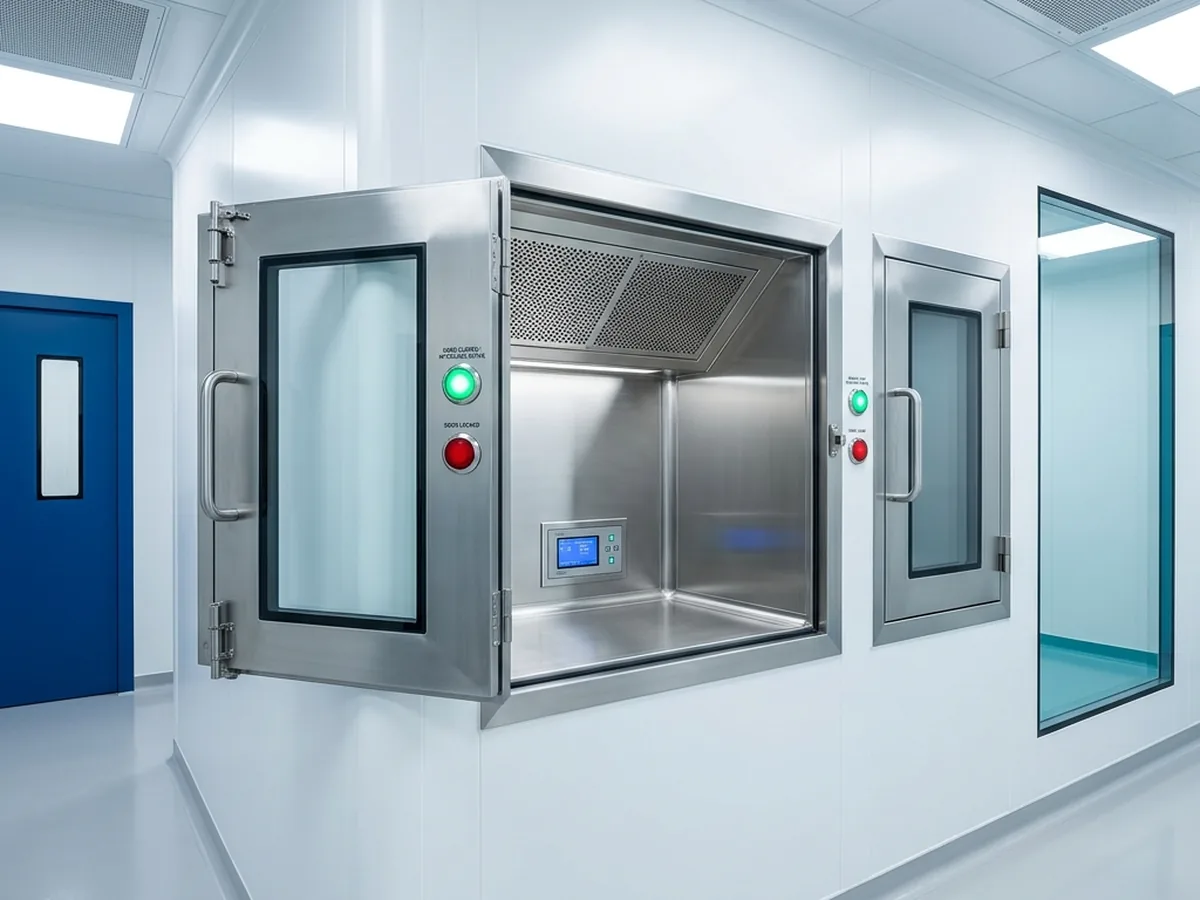
A pass box (pass-through chamber) is a small interlocked cabinet built into the wall between two spaces of different cleanliness. Material goes in on one side, the door closes, and only then can the opposite door open — so items transfer without a person walking the corridor-to-cleanroom route, and without the two atmospheres ever connecting directly.
- Static pass box: a simple interlocked chamber with no fan. Suitable between rooms of similar or adjacent grades, for documents, packaged components and tools.
- Dynamic pass box: adds its own fan and HEPA filtration so the chamber is actively purged with clean air between transfers. Specified at boundaries to higher grades, and common in pharmaceutical facilities in the Gulf.
Construction is typically SS304 with interlocks, UV lamp options and coved internal corners — see our pass-through chambers.
Air Shower vs Pass Box: Side-by-Side Comparison
| Aspect | Air shower | Pass box |
|---|---|---|
| What it handles | People, trolleys, drums, large items that must physically enter | Small materials: samples, documents, components, tools |
| Where it sits | On the personnel or cargo route, after gowning | In the wall between two rooms of different grade |
| How it works | High-velocity HEPA jets (~20–25 m/s) strip loose particles during a timed cycle | Interlocked chamber; dynamic versions purge with HEPA-filtered air |
| Airflow | Recirculated through G4 + H13/H14 filters | None (static) or HEPA-filtered purge (dynamic) |
| Interlocks | Electromagnetic, both doors, with emergency release | Mechanical or electromagnetic, both doors |
| Typical users | Pharma, food, electronics production staff at shift change | QC labs, pharma production, packaging, electronics assembly |
| Main benefit | Cleans what must come in | Stops entries that never needed to happen |
Which One Do You Need? A Decision Framework
Ask one question per movement across your cleanroom boundary: does a person actually need to go through?
- People must enter (operators, engineers): air shower on that route, after the gowning room.
- Only the item must cross (sample to QC, components to assembly, paperwork): pass box — static between similar grades, dynamic into higher grades.
- Large wheeled loads enter regularly: a cargo or tunnel air shower sized for the trolley, not a personnel unit.
- High-frequency small transfers between fixed rooms: a dynamic pass box at each transfer point keeps traffic out of airlocks entirely.
By industry: pharmaceutical plants typically need both (personnel shower plus dynamic pass boxes at every grade change); electronics facilities lean on air showers because boards and assemblies move with operators; food plants often pair a personnel shower with static pass boxes for packaging materials.
Can You Need Both? (Usually, Yes)
Treat them as complementary layers of the same contamination-control strategy. The air shower handles the entries you cannot avoid; the pass box eliminates the entries you can. Because every person entering a cleanroom sheds particles continuously — even when perfectly gowned — the cheapest particle you ever control is the entry that never happens. A facility that installs pass boxes at its routine transfer points typically cuts personnel movements substantially, which also reduces gowning consumption and airlock congestion at shift change.
When planning, walk your process flows on the layout drawing and mark every boundary crossing as either person or item. The marks tell you exactly how many of each unit you need — and where. Our engineers do this mapping as part of the design package; request a quote and send us your layout.
Common Specification Mistakes to Avoid
- Using a pass box as a cupboard. Storing items inside defeats the interlock discipline and contaminates the chamber.
- Specifying a static pass box into a Grade B/ISO 5 boundary. Higher-grade boundaries normally call for a dynamic, HEPA-purged unit.
- Undersizing the air shower. If a trolley or shift group cannot fit, staff will prop the doors — buy the cargo or multi-person format instead.
- No emergency release. Interlocks must fail safe and release on power loss; verify this behaviour at factory test.
- Forgetting filter access. Both units need pre-filter and HEPA access that does not break the cleanroom envelope.
- Ignoring the pressure cascade. Both devices only protect the cascade if room pressures are designed correctly in the first place — see our guide to ISO 14644 classes.
Related pages
Planning a cleanroom in the Gulf?
Get a free, no-obligation quote — export pricing, lead times and installation across the GCC.
Frequently Asked Questions
Common questions about cleanrooms, standards, cost and how Pak Gusu supplies and installs across the GCC.
What is the difference between an air shower and a pass box?
An air shower is a walk-through chamber that blows HEPA-filtered air over people or large items to remove loose particles before they enter a cleanroom. A pass box is a small interlocked cabinet in the wall used to transfer materials between rooms so personnel do not need to cross the boundary. One cleans what enters; the other prevents unnecessary entries.
Does every cleanroom need an air shower?
No. Neither ISO 14644 nor EU-GMP Annex 1 mandates an air shower by name — it is specified as part of your contamination-control strategy. They are standard practice at ISO 5–7 production entries in pharmaceutical, electronics and food facilities, but a low-grade room with disciplined gowning may not justify one.
When should I choose a dynamic pass box instead of a static one?
Choose a dynamic (HEPA-purged) pass box when transferring into a higher cleanliness grade, such as into an ISO 5/Grade B area, or wherever your risk assessment calls for active purging between transfers. Static pass boxes suit transfers between rooms of similar or adjacent grades, such as documents and packaged components.
Can an air shower replace gowning procedures?
No. An air shower removes loosely held particles from the outside of garments; it does not sterilise and it cannot compensate for poor gowning. It is a supplementary reduction step that works with, not instead of, your gowning and behaviour procedures.
How long does an air shower cycle take?
A typical cycle runs 10 to 30 seconds and is adjustable on the controller. During the cycle both doors stay electromagnetically locked, and the cleanroom-side door only releases after the jets stop, so throughput planning should allow roughly one minute per person or load including entry and exit.
Does Pak Gusu supply air showers and pass boxes to the Gulf?
Yes. Pak Gusu manufactures both in Lahore, Pakistan as the technical partner of GUSU Purification (China), and exports them on CIF/DAP terms via Jebel Ali, King Abdulaziz Port Dammam and Hamad Port to the UAE, Saudi Arabia, Qatar, Kuwait, Bahrain and Oman, with installation supervision available at extra cost.
Cleanrooms supplied & installed across the GCC
Manufactured in Pakistan with GUSU (China) technology · shipped to Jebel Ali, Dammam & Hamad (CIF/DAP) · installation available across the Gulf.