
Cleanroom HVAC and HEPA design is the engineering that decides whether a room holds its ISO class: it sets the air changes per hour (ACPH) for the cleanliness grade, the HEPA filter grade (H13 or H14 to EN1822), where those filters sit (terminal in the ceiling versus ducted in the air handling unit), the pressure cascade between rooms, and how tightly temperature and humidity are controlled. Get any one of these wrong and particle counts drift out of limit, recovery after an excursion takes too long, or HEPA filters blind prematurely.
Pak Gusu Technology (Pvt) Ltd designs and manufactures these systems at our factory in Lahore, Pakistan, as the technical partner of GUSU Purification (China), and supplies turnkey modular cleanrooms across Pakistan and the GCC. This page explains the design logic so you can specify a system correctly and brief us accurately, rather than buying filters and fans in isolation.
For the desert and hot-climate context specifically, every value below assumes a properly sized cooling and dehumidification load and graded pre-filtration ahead of the HEPA stage. Use the figures as design starting points; the final ACPH, airflow and HEPA count are confirmed by HVAC calculation and validation for your exact room, process and location.
Key takeaways
- ACPH scales steeply with ISO class: roughly 10-25 for ISO 8, 30-60 for ISO 7, 90-180 for ISO 6, and 240-600 for ISO 5 (or unidirectional flow) where the cleanest grades are required.
- HEPA grade follows the class: H13 (>= 99.95% at MPPS, EN1822) suits most ISO 7-8 rooms; H14 (>= 99.995%) is used for ISO 5-6 and EU-GMP Grade A/B critical zones.
- EU-GMP grades map to ISO classes by occupancy state, not one-to-one: Grade A is ISO 5; Grade B is ISO 5 at rest / ISO 7 in operation; Grade C is ISO 7 at rest / ISO 8 in operation; Grade D is ISO 8 at rest.
- Terminal HEPA (filter at the ceiling diffuser) is preferred for classified rooms; ducted HEPA in the AHU is used where terminal mounting is impractical, but loses the final point-of-use barrier.
- A pressure cascade of roughly 10-15 Pa between adjacent classified areas keeps air leaking from clean to less-clean, and in hot, dusty climates oversized cooling, tight dehumidification and graded G4 -> F7-F9 pre-filters protect the HEPA and hold setpoints through peak summer.
- Recovery time (how fast the room returns to class after a disturbance) is a function of ACPH and airflow uniformity, and is verified during validation, not assumed.
What does a cleanroom HVAC system actually have to do?
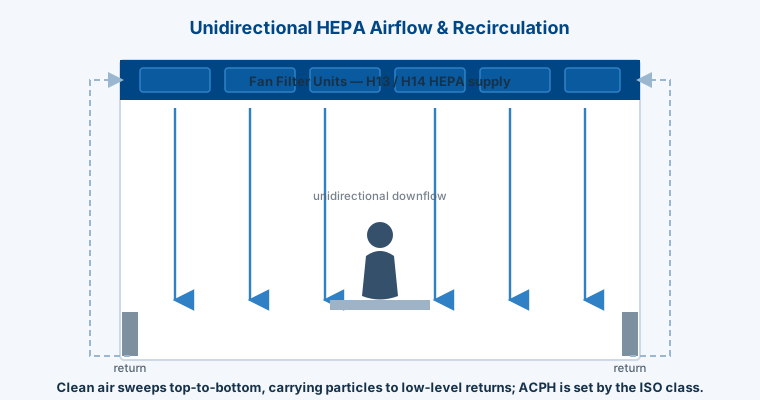
A cleanroom air handling system has four jobs that must be solved together, not separately. First, it must dilute and remove airborne particles by pushing a large, filtered air volume through the room every hour - that is the role of ACPH and HEPA filtration. Second, it must maintain a pressure cascade so contamination always moves from clean to less-clean spaces. Third, it must hold temperature and humidity within process and comfort limits. Fourth, it must do all of this efficiently, because air handling dominates a cleanroom's running cost.
The central component is the air handling unit (AHU): a packaged train of mixing/fresh-air section, cooling and dehumidification coil, optional reheat, supply fan, and filter banks. Conditioned air leaves the AHU, is distributed through ducting to ceiling HEPA terminals or fan-filter units, sweeps the room, and returns via low-wall grilles to be re-filtered and re-conditioned. A portion is exhausted and replaced with fresh outdoor air to control CO2, odour and room pressure. Our fan-filter units and laminar air flow units are the room-side delivery devices that the AHU feeds.
How many air changes per hour (ACPH) does each ISO class need?
ACPH is the number of times the entire room air volume is replaced each hour. It is the single most important HVAC number because it sets the supply airflow, which in turn sets the number of HEPA fan-filter units in the ceiling and the AHU capacity. Cleaner classes need dramatically more air changes. The table below pairs each ISO 14644-1 class with a typical at-rest ACPH design band, the airflow regime, the usual HEPA grade, and the nearest EU-GMP grade. Note that EU-GMP grades are defined by two particle limits - one at rest and one in operation - so they do not map one-to-one onto a single ISO class; the table shows the closest correspondence with the occupancy state stated.
| ISO 14644-1 class | Typical ACPH (design band) | Airflow regime | Typical HEPA grade (EN1822) | Nearest EU-GMP grade (state) |
|---|---|---|---|---|
| ISO 8 | 10-25 | Non-unidirectional (turbulent) | H13 | Grade D (at rest); Grade C in operation |
| ISO 7 | 30-60 | Non-unidirectional (turbulent) | H13 (H14 where required) | Grade C (at rest); Grade B in operation |
| ISO 6 | 90-180 | Non-unidirectional / partial unidirectional | H14 | No direct Annex 1 grade (between B and C; common in electronics/non-sterile) |
| ISO 5 | 240-600 (or unidirectional ~0.36-0.54 m/s) | Unidirectional (laminar) | H14 | Grade A; also Grade B at rest |
For ISO 5 / Grade A zones the meaningful target is usually air velocity across a HEPA ceiling (EU-GMP Annex 1 guidance is in the order of 0.36-0.54 m/s, commonly designed around 0.45 m/s) and percentage HEPA coverage rather than a simple ACPH figure, though an equivalent ACPH is often quoted. Plug your own room area, height and class into the cleanroom cost & ACPH calculator to see the recommended air changes, supply airflow and indicative HEPA fan-filter unit count for your project.
H13 vs H14 HEPA, and terminal vs ducted filtration
HEPA filters are graded under EN1822 by their efficiency at the Most Penetrating Particle Size (MPPS). H13 captures at least 99.95% at MPPS and is the workhorse for ISO 7 and ISO 8 rooms. H14 captures at least 99.995% and is specified for ISO 5-6 and EU-GMP Grade A/B critical areas. Choosing a higher grade than the class requires wastes fan energy through unnecessary pressure drop; choosing too low risks failing classification.
Equally important is where the HEPA sits:
- Terminal HEPA - the filter is housed at the ceiling diffuser or inside a fan-filter unit at the point of supply. This is the standard for classified rooms because the final, most efficient barrier sits downstream of all ducting, so any duct leakage or shedding is captured before air enters the room.
- Ducted (AHU-mounted) HEPA - the HEPA bank sits in the air handling unit and clean air travels through ductwork to the room. This can simplify ceiling design and maintenance access, but the ducting between filter and room is no longer protected, so it is generally reserved for lower classes or where terminal mounting is impractical.
HEPA filters are the final barrier, not the workhorse. They are protected by upstream pre-filters (typically a coarse G4 panel for sand and debris, then F7-F9 fine filters for respirable dust) so the expensive terminal HEPAs last years rather than months. Differential pressure across each bank is monitored to time filter changes before airflow starves.
Pressure cascade, recovery and temperature/humidity control
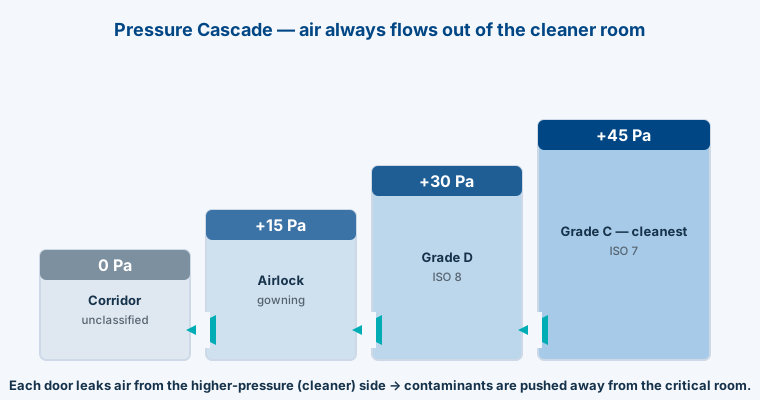
A pressure cascade keeps contamination moving in one direction. By holding each cleaner room at a higher pressure than its less-clean neighbour, air always leaks out of the clean space, never in. A differential of roughly 10-15 Pa between adjacent classified areas is a common design target, with airlocks, gowning rooms and pass-through chambers forming the stepped transitions. Our pass-through chambers and air showers are part of how that cascade is maintained at material and personnel entry points.
Recovery time is how quickly a room returns to its class after a disturbance such as a door opening or a process release. It depends directly on ACPH and on how uniformly air sweeps the room - a high air-change rate with dead zones recovers poorly. Recovery is measured during validation, not assumed.
Temperature and humidity are controlled at the AHU coil and reheat stage. Many pharmaceutical, nutraceutical and electronics processes need a stable setpoint with a tight band; humidity control protects products, prevents condensation on cold surfaces (which feeds microbial growth) and manages static in electronics. In hot climates the cooling and dehumidification load is large and must be sized with generous margin so setpoints hold through peak summer afternoons.
Desert and hot-climate considerations for the GCC and Pakistan
Gulf and Pakistani summers combine three stresses at once: extreme heat, large humidity swings, and persistent fine dust. Each one attacks a different part of the HVAC system, and a design that ignores climate will chase faults every summer.
- Heat demands oversized cooling capacity so the room holds its temperature setpoint at peak ambient, otherwise particle counts and operator comfort both suffer.
- Humidity needs tight dehumidification (often deep-cooling plus reheat) to avoid condensation on cold ductwork and surfaces.
- Dust requires a heavy graded intake filtration train - G4 then F7-F9 - ahead of the HEPA, so terminal filters are not blinded within months. Expect pre-filter change intervals to be far shorter than HEPA intervals by design; that is the system working as intended.
Energy recovery on the exhaust stream and variable-speed fans help control the running cost that this margin creates. For region-specific delivery, validation and logistics context, see our GCC cleanroom hub; installation supervision in the Gulf is available at extra cost. For a deeper treatment of class selection, read our blog on ISO 14644 cleanroom classes to confirm the class your process needs first.
What to check before you sign off an HVAC & HEPA design
These are the questions that separate a system that holds its class from one that fails commissioning. Use them to interrogate any supplier's proposal - including ours.
- Is the ACPH justified for the class and process, not just the class? A room with heat-generating equipment or high personnel density may need more than the table band. Ask to see the airflow calculation.
- Where do the HEPA filters sit? Terminal HEPA is expected for classified rooms; if a proposal uses ducted-only HEPA for an ISO 7 room, ask why.
- Is the HEPA grade matched to the class? H13 for ISO 7-8, H14 for ISO 5-6 and Grade A/B. Over-grading wastes energy; under-grading fails.
- Is the pressure cascade complete? Every airlock, gowning room and pass-through should have a defined differential and a direction. Check for any "island" room with no defined cascade.
- Is the cooling and dehumidification load sized for local peak conditions, not a generic figure? In the GCC this is non-negotiable.
- Is the pre-filtration graded and monitored? Differential-pressure gauges on each bank, with a maintenance plan, protect the HEPA investment.
- Is the design validation-ready? The system should be specified so it can be commissioned and tested through IQ/OQ/PQ - we engineer to support your IQ/OQ/PQ rather than claiming it as done.
The cost of an HVAC and HEPA system is driven by the ISO class, the floor area, the required ACPH, the finishes, the HVAC capacity and the validation scope - not a single per-square-metre figure. To see how those factors move the budget, use the cost calculator, then request an itemised quote for your exact room.
Standards, regulatory framing and validation
The engineering on this page is anchored to recognised standards, and we are careful to frame compliance honestly: we design and manufacture systems to meet these requirements and to support your submission - we do not present certifications or approvals as accomplished facts.
- ISO 14644-1 classifies cleanliness by airborne particle concentration (the ISO 5-8 classes used throughout this page) and defines how rooms are tested.
- EU-GMP Annex 1 defines Grades A-D for the manufacture of sterile medicinal products, each with at-rest and in-operation particle limits, and drives the contamination-control strategy that the HVAC must deliver.
- EN1822 classifies HEPA filters (H13, H14) by efficiency at MPPS.
- IQ/OQ/PQ - Installation, Operational and Performance Qualification - is the validation sequence that proves the installed system performs. Our designs are validation-ready and we support your qualification effort; for the Gulf process see our guide to cleanroom validation (IQ/OQ/PQ) in the Gulf.
For Pakistan-based pharmaceutical projects, the regulator is DRAP (Drug Regulatory Authority of Pakistan), and Pakistan is a PIC/S applicant. We engineer rooms to support your GMP/DRAP submission; the regulatory approval itself rests with you and the authority. For the broader applications and sector context, see our pharmaceutical & nutraceutical cleanrooms page and the full cleanroom services overview.
Related pages
Ready to start your GCC cleanroom project?
Get a free, no-obligation quote — export pricing, lead times and installation across the GCC.
Frequently Asked Questions
Common questions about cleanrooms, standards, cost and how Pak Gusu supplies and installs across the GCC.
What is the difference between H13 and H14 HEPA filters?
Both are HEPA grades under EN1822, rated by efficiency at the Most Penetrating Particle Size (MPPS). H13 captures at least 99.95% at MPPS and is typical for ISO 7-8 rooms. H14 captures at least 99.995% and is used for ISO 5-6 and EU-GMP Grade A/B critical zones. Specifying a higher grade than the class needs wastes fan energy through extra pressure drop, while specifying too low risks failing classification.
How many air changes per hour does an ISO 7 or ISO 8 cleanroom need?
As a design starting point, ISO 8 rooms typically use about 10-25 ACPH and ISO 7 about 30-60 ACPH. ISO 6 rises to roughly 90-180 ACPH and ISO 5 to 240-600 ACPH or unidirectional flow in the order of 0.36-0.54 m/s. The final value is confirmed by HVAC calculation and validation for your specific room, process load and personnel density. You can estimate yours with our cleanroom cost and ACPH calculator.
How do EU-GMP grades map to ISO 14644 classes?
They do not map one-to-one, because each EU-GMP Annex 1 grade has two particle limits - one at rest and one in operation. Grade A corresponds to ISO 5. Grade B is ISO 5 at rest and ISO 7 in operation. Grade C is ISO 7 at rest and ISO 8 in operation. Grade D is ISO 8 at rest. ISO 6 has no direct Annex 1 equivalent and is more commonly specified in electronics and non-sterile contexts. Always confirm the grade and occupancy state your process must meet before fixing the ACPH and HEPA design.
Should HEPA filters be terminal (ceiling) or ducted in the AHU?
For classified cleanrooms, terminal HEPA - housed at the ceiling diffuser or in a fan-filter unit at the point of supply - is preferred because the final, most efficient barrier sits downstream of all ductwork, so any duct leakage is captured before air reaches the room. Ducted HEPA mounted in the air handling unit can simplify ceiling design but loses that point-of-use protection, so it is generally reserved for lower classes or where terminal mounting is impractical.
How do you stop desert dust from destroying HEPA filters in the Gulf?
Use a graded pre-filtration train ahead of the HEPA stage: a coarse G4 panel at the intake for sand and debris, then F7-F9 fine filters for respirable dust. This captures most particulates before they reach the HEPA, extending its life from months to years. Differential-pressure gauges on each bank tell the maintenance team when to change a pre-filter before it starves airflow. Pre-filter change intervals are deliberately much shorter than HEPA intervals.
Does Pak Gusu design HVAC and HEPA systems, and where?
Yes. Pak Gusu Technology (Pvt) Ltd designs and manufactures cleanroom HVAC and HEPA filtration at our factory in Lahore, Pakistan, as the technical partner of GUSU Purification (China), and supplies across Pakistan and the GCC (UAE, Saudi Arabia, Qatar, Kuwait, Bahrain and Oman). Systems are engineered to meet ISO 14644-1 and EU-GMP Annex 1 and to support your IQ/OQ/PQ validation. Installation supervision is available at extra cost. Request a quote to discuss your room.
Cleanrooms supplied & installed across the GCC
Manufactured in Pakistan with GUSU (China) technology · shipped to Jebel Ali, Dammam & Hamad (CIF/DAP) · installation available across the Gulf.