
A GMP cleanroom in Pakistan is a controlled-environment facility designed and built to satisfy EU-GMP Annex 1 cleanliness Grades A to D, mapped onto ISO 14644-1 particle classes, so that a pharmaceutical or nutraceutical manufacturer can run a process that the Drug Regulatory Authority of Pakistan (DRAP) will accept on inspection. Pak Gusu Technology manufactures modular cleanroom systems at its Lahore factory — wall and ceiling panels, doors, pass boxes, HVAC interfaces, HEPA terminals and pressure-cascade hardware — engineered to be validation-ready for your IQ, OQ and PQ.
We are a cleanroom manufacturer and the technical partner of GUSU Purification (China); we are not a regulator, a notified body or a certification scheme. That distinction matters: we build rooms designed to meet GMP and engineered to support your DRAP dossier, but the GMP certificate, the Drug Manufacturing Licence and the section-wise approval are issued to you, the licence holder, after DRAP inspects your facility, documentation and validation evidence.
This page maps the EU-GMP Annex 1 grades to ISO 14644 classes, explains where DRAP expectations and PIC/S alignment sit (Pakistan is a PIC/S applicant, not yet a member), and walks through the gowning, pressure-cascade and environmental-monitoring decisions that determine whether your room passes in operation — not just at rest.
Key takeaways
- EU-GMP Annex 1 Grades A-D map to ISO 14644-1 classes, but a single ISO number never fully describes a GMP room: Grade B is ISO 5 at rest and ISO 7 in operation.
- DRAP is Pakistan's pharma regulator; it inspects against GMP and issues your licence and GMP status — a cleanroom is never 'GMP certified' by its supplier.
- Pakistan is a PIC/S applicant (not a member). Designing to PIC/S-aligned GMP and EU Annex 1 supports both DRAP submission and any future export-market expectations.
- A compliant room must hold its grade in operation, recover quickly after disturbance, and be backed by qualification evidence — IQ, OQ and PQ — that you can show an inspector.
- Cost is driven by ISO class, area, air changes per hour, finishes, HVAC capacity and validation scope — not by a single headline figure.
- Pak Gusu manufactures in Lahore and serves Pakistan plus the GCC; installation supervision is available at extra cost.
How do EU-GMP Annex 1 grades map to ISO 14644 classes?
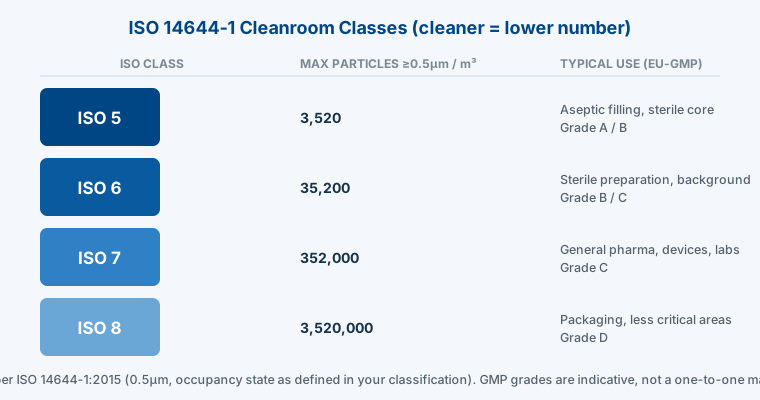
EU-GMP Annex 1 (2022) defines four pharmaceutical cleanliness grades — A, B, C and D — tied to airborne particle limits, while ISO 14644-1 classifies cleanrooms numerically by particle concentration. The two systems align closely, but Annex 1 adds requirements ISO does not: separate at-rest and in-operation limits, microbial (viable) limits, and a Contamination Control Strategy. The table below is the working mapping our Pakistani pharma and nutraceutical clients design around.
| EU-GMP Grade | ISO 14644 (at rest) | ISO 14644 (in operation) | Typical use in a Pakistani plant |
|---|---|---|---|
| Grade A | ISO 5 | ISO 5 | Critical zone: aseptic filling, open sterile product, under unidirectional (laminar) airflow |
| Grade B | ISO 5 | ISO 7 | Background to Grade A for aseptic processing |
| Grade C | ISO 7 | ISO 8 | Less critical preparation, solution compounding, terminally sterilised product stages |
| Grade D | ISO 8 | Set by risk / CCS* | Support areas: gowning, component prep, non-sterile manufacturing, nutraceutical packing |
*For Grade D in operation, Annex 1 expects limits to be set from your Contamination Control Strategy and risk assessment rather than a single fixed value. Note the pivot: the same Grade B room is ISO 5 at rest but ISO 7 in operation — which is exactly why you must engineer for the worst-case in-operation load, then verify the at-rest state is comfortably cleaner. See our deeper explainer on ISO 14644 cleanroom classes and the term definitions in our cleanroom glossary.
What does DRAP expect, and where does PIC/S fit in?
The Drug Regulatory Authority of Pakistan (DRAP) licenses pharmaceutical manufacturers and inspects facilities against Good Manufacturing Practice before granting and renewing a Drug Manufacturing Licence and section-wise approvals. DRAP's GMP framework is broadly aligned with WHO and EU-GMP principles, so designing your cleanroom to EU-GMP Annex 1 and ISO 14644 puts you on solid ground for a DRAP inspection.
On PIC/S: Pakistan is a PIC/S applicant — it is not yet a PIC/S member. We state this accurately and do not overclaim. Building to PIC/S-aligned GMP and Annex 1 today is sensible for two reasons: it matches the direction DRAP is moving in, and it strengthens your position for export markets that expect internationally harmonised GMP. What we provide is hardware and design engineered to support your DRAP submission — the qualification dossier, the GMP certificate and the licence are issued to you after inspection. We do not, and cannot, supply a room that is itself 'GMP certified' or 'DRAP approved'.
If your scope spans both Pakistan and the Gulf, our GCC cleanroom programme covers the parallel GCC regulatory expectations — for example Saudi SFDA and the wider Gulf Health Council framework — across the six GCC states.
Gowning, pressure cascade and airflow: the three things inspectors look at first
Three engineering decisions decide whether a room holds its grade in practice:
- Pressure cascade. Air must flow from cleaner to less-clean areas. A typical cascade steps down by roughly 10-15 Pa between adjacent graded zones, with the highest pressure at the Grade A/B core and the lowest at the gowning entry. Airlocks and interlocked doors maintain the differential; we supply cleanroom doors and pass-through chambers sized for the cascade.
- Gowning flow. Personnel are the largest contamination source, so gowning rooms are sequenced (street clothing - changing - clean gown - airlock) with a clear demarcation line. An air shower at the boundary removes loose particulate before entry to higher grades.
- Airflow and filtration. Air change rates (ACPH) and HEPA filtration (H13/H14 to EN 1822) are sized for the in-operation worst case. Grade A uses unidirectional airflow via laminar air-flow units; lower grades use terminal HEPA via fan filter units. Recovery time — how fast the room returns to its grade after a disturbance — is a tested OQ parameter.
Environmental monitoring: proving the room performs in operation
A GMP cleanroom is only as good as the monitoring evidence behind it. Annex 1 expects a documented environmental monitoring (EM) programme covering non-viable particles (continuous in Grade A, periodic in lower grades) and viable monitoring (settle plates, active air sampling, contact plates and personnel monitoring). Grade A and Grade B both hold the ISO 5 particle limit at rest, and the critical Grade A zone holds ISO 5 in operation too — because that is where sterile product is exposed.
Our cleanroom hardware is built to make EM workable: smooth, cleanable, non-shedding wall and ceiling panels with coved corners, flush-mounted HEPA terminals, and accessible sampling points. We supply the room validation-ready and support your IQ/OQ/PQ — see our walkthrough of IQ, OQ and PQ validation. The EM programme, the data, and the trended results that satisfy DRAP remain the responsibility of your quality unit.
What to check and common concerns before you commit
Before signing off a GMP cleanroom design for a Pakistani facility, pressure-test it against these points:
- "Is it GMP certified?" No supplier can hand you a GMP-certified room. Be wary of anyone claiming it. The honest position is a room designed to meet Annex 1 and engineered to support your DRAP submission; the certificate is earned by you on inspection.
- At rest vs in operation. Confirm the HVAC, ACPH and filtration are sized for the in-operation state, not just the easier at-rest classification. A room specified only for at-rest will fail when staff and equipment load the air.
- Recovery time and pressure stability. Ask how the design holds the pressure cascade when doors open and how quickly it recovers — both are tested in OQ.
- Materials and finishes. Panels, doors and windows must be non-shedding, chemically resistant and cleanable, with no horizontal ledges that trap particulate.
- Documentation handover. Confirm you receive the design drawings, material certificates and test-point references your validation team needs to build the qualification dossier.
- Installation. We manufacture in Lahore; installation supervision is available at extra cost. Clarify scope early so site readiness and local trades are coordinated.
To turn a design into a documented quote, use get a quote and tell us your grades, areas and process.
What drives the cost of a GMP cleanroom in Pakistan?
We do not publish prices on this page, because a credible figure depends entirely on your scope. The cost of a GMP cleanroom is driven by:
| Cost factor | Why it moves the number |
|---|---|
| Target ISO class / GMP grade | Grade A/B (ISO 5) demands more HEPA coverage, tighter cascade and unidirectional airflow than Grade D (ISO 8) |
| Cleanroom area and height | More panel area, ceiling grid and conditioned volume |
| Air changes per hour (ACPH) | Higher ACPH needs larger AHUs, more fan filter units and more energy |
| Finishes and materials | Panel type, coving, door and window specification, flooring |
| HVAC capacity | Cooling, dehumidification and makeup-air load — higher in hot, dusty conditions |
| Validation scope | The depth of IQ/OQ/PQ support and documentation you require |
To put real numbers against your own grades, area and ACPH, use the cleanroom cost calculator — it is the one place on this site that computes indicative figures. For an exact, documented proposal, request a quote.
Standards and regulatory references
A GMP cleanroom for the Pakistani pharma and nutraceutical sector is designed against an interlocking set of standards. The core references are:
- EU-GMP Annex 1 (2022) — cleanliness Grades A-D, at-rest vs in-operation limits, viable monitoring and the Contamination Control Strategy.
- ISO 14644-1 / -2 — airborne particle classification (ISO 5-8 for pharma) and monitoring of cleanliness by particle concentration.
- EN 1822 — HEPA filter classification (H13/H14) used in terminals and laminar units.
- DRAP GMP framework — Pakistan's regulatory basis for licensing and inspecting manufacturers; broadly aligned with WHO and EU principles.
- PIC/S guidance — internationally harmonised GMP. Pakistan is a PIC/S applicant, not a member; designing to PIC/S-aligned GMP supports both DRAP and export readiness.
For the pharmaceutical and nutraceutical side specifically, see our pharma & nutraceutical cleanrooms page; for the full equipment range, browse our cleanroom products.
Related pages
Ready to start your GCC cleanroom project?
Get a free, no-obligation quote — export pricing, lead times and installation across the GCC.
Frequently Asked Questions
Common questions about cleanrooms, standards, cost and how Pak Gusu supplies and installs across the GCC.
Can Pak Gusu supply a 'GMP certified' cleanroom in Pakistan?
No — and no honest manufacturer can. A cleanroom is designed and built to meet GMP, but GMP certification is granted to you, the licence holder, by DRAP after it inspects your facility, documentation and validation evidence. We supply rooms designed to meet EU-GMP Annex 1, manufactured in Lahore, and engineered to support your DRAP submission and your IQ/OQ/PQ. The certificate is earned by you on inspection, not sold by a supplier.
Is Pakistan a member of PIC/S?
No. Pakistan is a PIC/S applicant, not a member. We state this accurately rather than overclaiming. Designing your cleanroom to PIC/S-aligned GMP and EU-GMP Annex 1 is still worthwhile: it matches DRAP's direction of travel and strengthens your readiness for export markets that expect internationally harmonised GMP.
Which ISO class corresponds to EU-GMP Grade A in a pharma cleanroom?
EU-GMP Grade A corresponds to ISO 5, and that limit must be held in both the at-rest and in-operation states because it is the critical zone where sterile product is exposed. Grade A is typically protected by unidirectional (laminar) airflow. The Grade B background is ISO 5 at rest but ISO 7 in operation, Grade C is ISO 7 at rest and ISO 8 in operation, and Grade D is ISO 8 at rest with in-operation limits set by your risk assessment.
What does DRAP look at when inspecting a cleanroom?
DRAP inspects against GMP: the design and qualification of the cleanroom, the pressure cascade and airflow, the environmental monitoring programme (non-viable and viable), gowning and personnel flow, and the documentation that proves the room performs in operation. The supporting qualification evidence — IQ, OQ and PQ — must be available for the inspector. We supply the room validation-ready and support your team in producing that evidence.
Why does a single ISO class number not fully describe a GMP cleanroom?
Because EU-GMP Annex 1 requires compliance in two states — at rest and in operation — and the permitted limit can differ between them. The same Grade B room is ISO 5 at rest but ISO 7 in operation. ISO 14644 also does not cover the viable (microbial) monitoring and Contamination Control Strategy that GMP demands. You therefore specify by grade and state, then verify the corresponding ISO class in each state.
How much does a GMP cleanroom cost in Pakistan?
There is no single figure, because the cost depends on your ISO class, cleanroom area, air changes per hour, finishes, HVAC capacity and validation scope. A Grade A/B (ISO 5) suite costs far more per square metre than a Grade D (ISO 8) support area. To get an indicative number against your own parameters, use our cleanroom cost calculator; for an exact, documented proposal tailored to your process, request a quote.
Cleanrooms supplied & installed across the GCC
Manufactured in Pakistan with GUSU (China) technology · shipped to Jebel Ali, Dammam & Hamad (CIF/DAP) · installation available across the Gulf.