
Most food factories in the GCC need a hygienic high-care room rather than a fully ISO-classified cleanroom. A hygienic room controls microbial and physical contamination around exposed product, while an ISO 14644 cleanroom adds formally measured airborne particle limits — a step only specific products such as infant formula, powdered nutraceuticals and certain ready-to-eat or dairy lines actually require.
The practical question is therefore not “cleanroom or not”, but how clean the air, surfaces and pressure regime must be at the point where food is exposed. This guide explains where each room type fits, how the build supports your HACCP plan, the typical specifications for high-care zones, and the Gulf-specific factors — heat, humidity and port logistics — that shape a food-grade build for the region.
Key takeaways
- Most food plants need a hygienic high-care room; ISO classification is reserved for higher-risk products such as infant formula, powdered supplements and aseptic dairy.
- A high-care room controls surfaces, airflow and pressure cascade; an ISO-classified cleanroom adds measured particle counts and terminal HEPA filtration.
- Your HACCP or food-safety consultant defines the critical control points (CCPs) — Pak Gusu builds the physical envelope designed to support those controls and your inspections.
- Washdown panels, radius coving, hygienic drainage and positive-pressure filtered air are the core of any high-care build.
- Gulf heat and humidity drive HVAC and condensation control, so the room and its air handling must be sized for local ambient conditions, not a temperate climate.
- Modular construction ships flat-packed to Jebel Ali, Dammam or Hamad and assembles on site, which simplifies import and future expansion.
Does a food factory need a cleanroom or a hygienic room?
The honest answer for most plants is a hygienic high-care room, not a particle-classified cleanroom. The driver is product risk, not the word on the door. Food safety practice divides production into low-risk areas (raw handling, primary processing), high-care areas (cooked or treated product that will receive no further kill step), and high-risk areas (exposed ready-to-eat product where any recontamination is unacceptable).
Where product is exposed after a kill step — slicing cooked meat, assembling chilled ready meals, filling sauces, portioning cheese — you need controlled air, hygienic surfaces and a positive-pressure regime that keeps the cleaner zone protected from adjacent areas. That is a hygienic high-care room. A formally ISO-classified cleanroom only becomes necessary when the contamination limits must be measured and documented to a standard. Many GCC builds combine both: hygienic envelopes throughout with one or two ISO-classified zones for the most sensitive step. If you are still mapping your zones, our food and beverage industry page and the wider GCC cleanroom overview set out the options.
Which food products justify an ISO-classified cleanroom?
ISO 14644 classification makes sense when the airborne particle and microbial environment has to be measured, controlled and proven — typically because the product is consumed by vulnerable groups, has a long ambient shelf life, or is a dry powder that cannot be re-sterilised. Common examples include:
- Infant formula and follow-on milk powders, where regulators and customers expect tightly controlled filling and packing environments.
- Powdered nutraceuticals and food supplements, which often share standards with pharmaceutical practice.
- Aseptic or extended-shelf-life dairy and certain liquid fillings.
- Ready-to-eat assembly for chilled meals where the product never sees another heat step.
For these, a target of around ISO 8 (sometimes ISO 7 at the most exposed point) with terminal HEPA filtration is typical. If the ISO class itself is new to your team, our explainer on ISO 14644 cleanroom classes and the cleanroom glossary translate the numbers into plain language.
How does HACCP-aligned zoning shape the room design?
HACCP defines where contamination must be controlled; the room turns those decisions into physical separation, airflow and pressure. To be clear about responsibilities: your HACCP or food-safety consultant identifies the hazards and defines the critical control points (CCPs). Pak Gusu builds the envelope designed to support those controls — we do not write your HACCP plan or grant food-safety approvals.
In practice that means we translate your zoning map into a cascade of rooms at descending risk, with the high-care zone held at the highest positive pressure so air always moves from clean to less-clean. Personnel and material flows are separated with airlocks, gowning lobbies and pass-through chambers so that nothing crosses a hygiene boundary uncontrolled. Drainage falls away from clean areas, and surfaces are specified for the cleaning chemistry your plan calls for. When it is time to demonstrate that the built room performs, our validation support helps you assemble the evidence your auditors and customers expect.
What specifications do high-care food areas typically use?
A well-built high-care room is defined by a handful of consistent specifications. None are exotic, but each one matters for cleanability and for passing inspection:
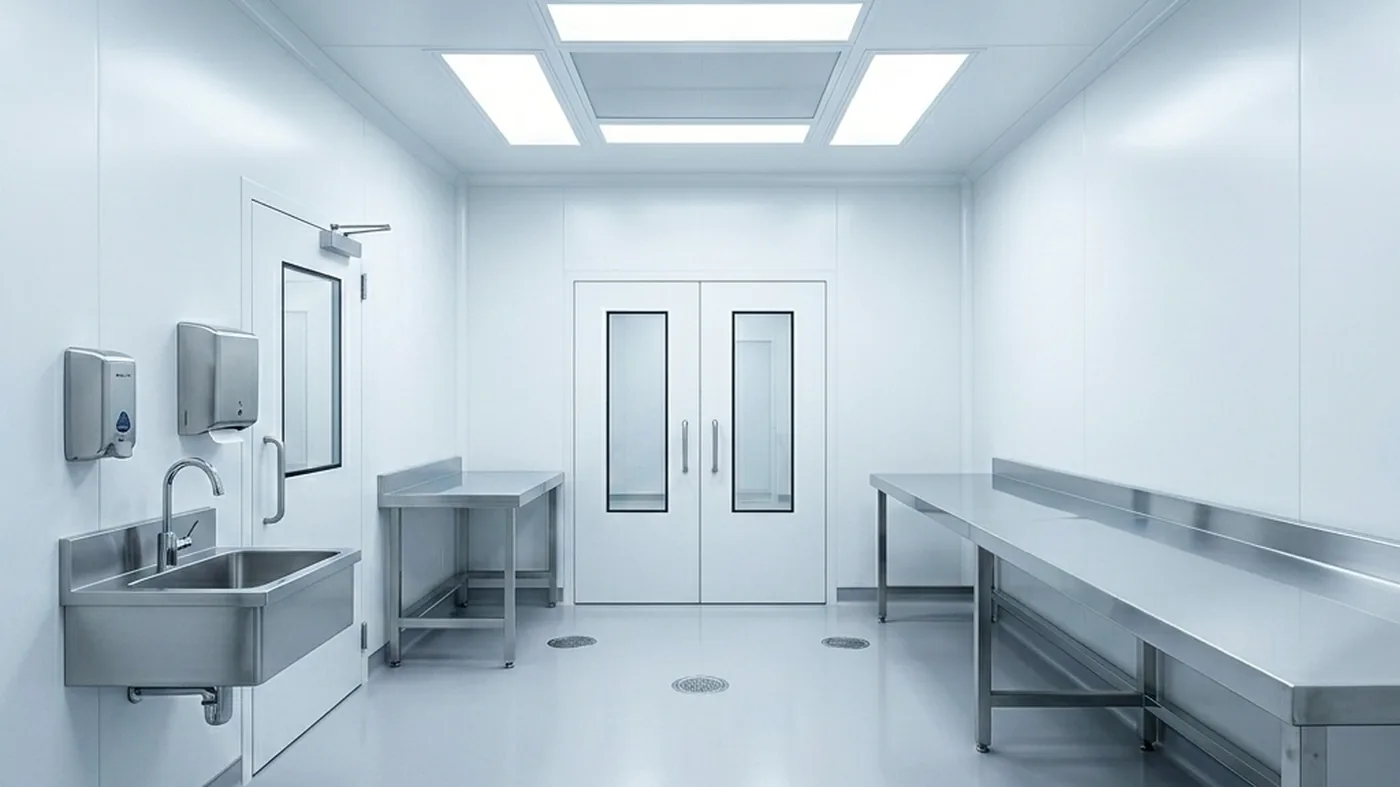
- Washdown wall and ceiling panels — sealed, food-grade faced sandwich panels with smooth, non-shedding, impact-resistant surfaces that tolerate daily wet cleaning and sanitiser. See our cleanroom panels for face and core options.
- Radius coving at wall-to-wall, wall-to-floor and wall-to-ceiling junctions to remove the 90° corners where soil and bacteria collect.
- Hygienic drainage — sloped floors to slot or gully drains with cleanable traps, kept out of the most sensitive zones where possible.
- Positive-pressure, filtered air — a maintained pressure cascade (commonly in the order of 10–15 Pa between zones) with fine pre-filtration and terminal HEPA H13/H14 where an ISO-classified result is required.
- Flush, sealed details — hygienic cleanroom doors, vision panels, glands and sealed light fittings with no horizontal ledges.
For a high-care, non-classified room, the goal is reliable surface and air hygiene rather than a certified particle count; for an ISO 8-style zone, the same envelope is paired with HEPA terminals and a monitored cascade.
Hygienic room vs ISO-classified cleanroom: how do they compare?
The table below summarises where each room type sits. Many GCC factories specify a hygienic envelope throughout and upgrade only the most sensitive step to a classified zone.
| Attribute | Hygienic / high-care room | ISO-classified cleanroom |
|---|---|---|
| Primary goal | Control microbial and physical contamination on exposed product | Defined, measured airborne particle and microbial limits |
| Air filtration | Fine filters (F7–F9), terminal HEPA optional | Terminal HEPA H13/H14 at supply |
| Particle status | Not formally classified | Classified, e.g. ISO 7–ISO 8 |
| Pressure regime | Positive cascade to lower-care areas | Validated, monitored pressure cascade |
| Typical products | Chilled ready meals, bakery high-care, sauces, cheese | Infant formula, powdered supplements, aseptic dairy |
| Verification | Cleaning, swabbing and environmental monitoring | Formal qualification plus particle counts |
| Construction | Washdown panels, coving, hygienic drainage | Same envelope plus airlocks and tighter finishes |
What Gulf-specific factors affect a food-grade build?
Three local realities change the design compared with a temperate-climate plant. First, heat and humidity: summer ambient temperatures across the Gulf can approach 45–50 °C, and coastal sites near Jebel Ali, Dammam and Hamad carry a heavy moisture load. The air-handling and panel specification must manage that load, prevent condensation on cold surfaces in chilled high-care rooms, and hold stable temperature and relative humidity at the production line.
Second, inspections: your facility will be assessed by the relevant municipal or national food-control authority for the emirate or country you operate in. Pak Gusu does not issue or hold those approvals — we build the room with the cleanable surfaces, drainage and documentation designed to support a smooth inspection. Third, logistics: modular rooms ship flat-packed and assemble on site, so import and any future expansion stay manageable. Our shipping and installation guide explains CIF and DAP delivery to the main GCC ports, with installation or supervision available at extra cost.
What makes the construction genuinely cleanable?
Cleanability is designed in, not added later. Every junction is coved so there are no square internal corners; panel joints are sealed with food-grade silicone and kept flush; and surfaces are selected to resist the sanitisers and wash cycles your cleaning schedule specifies. Services — cabling, pipework, ducting — run above the ceiling or within the wall cavity rather than across the room, so there are no horizontal ledges to trap soil.
Floors are typically slip-resistant, chemical-resistant resin or hygienic sheet systems coved up the wall, laid to falls toward hygienic drains. Doors close flush with smooth faces and concealed or hygienic ironmongery, and light fittings are sealed and recessed. The result is a shell that can be cleaned to a verifiable standard shift after shift — which is what your auditors, and your own quality team, ultimately care about.
How do you specify and import a food-grade room into the GCC?
Start with your product risk and HACCP zoning, then decide which areas are high-care hygienic rooms and which (if any) need ISO classification. From there, the envelope, air handling and drainage follow. Pak Gusu manufactures the modular system in Lahore as the technical partner of GUSU Purification, ships it to your nearest Gulf port, and can supply installation or on-site supervision at extra cost.
To move forward, send your floor area, ceiling height, target product and any classification requirement and we will scope a build. You can request a quote for a tailored specification, or use the cleanroom cost calculator to model a budget for a high-care or ISO 8-style food zone before you commit.
Related pages
Planning a cleanroom in the Gulf?
Get a free, no-obligation quote — export pricing, lead times and installation across the GCC.
Frequently Asked Questions
Common questions about cleanrooms, standards, cost and how Pak Gusu supplies and installs across the GCC.
Do all food factories in the GCC need a cleanroom?
No. Most food plants need a hygienic high-care room that controls surfaces, airflow and pressure around exposed product, not a particle-classified cleanroom. ISO 14644 classification is reserved for higher-risk products such as infant formula, powdered supplements and aseptic dairy. Many factories combine hygienic envelopes throughout with one classified zone for the most sensitive step.
What is the difference between a hygienic room and a cleanroom?
A hygienic high-care room is built to control microbial and physical contamination using washdown surfaces, coving, drainage and positive pressure, but it is not formally classified. An ISO-classified cleanroom adds measured airborne particle limits, terminal HEPA filtration and a monitored pressure cascade that must be proven. In short, every cleanroom is hygienic, but not every hygienic room is a classified cleanroom.
What ISO class is used for food cleanrooms?
Food cleanrooms typically target around ISO 8, with the most exposed point sometimes specified to ISO 7. The exact target depends on the product and your customers' or regulators' expectations. The room is paired with terminal HEPA H13 or H14 filters and a maintained positive-pressure cascade to achieve and hold that class.
Can Pak Gusu get our room approved by the food authority?
No. Municipal and national food-control authorities inspect and approve facilities, not cleanroom suppliers, and we never claim to hold or grant those approvals. What we do is build the room with cleanable surfaces, hygienic drainage, pressure control and documentation designed to support your inspection. Your HACCP or food-safety consultant remains responsible for the food-safety system itself.
Do you write our HACCP plan?
No. Your HACCP or food-safety consultant identifies the hazards and defines the critical control points. Pak Gusu builds the physical envelope — zoning, airflow, pressure cascade and hygienic finishes — designed to support those controls. We are happy to work alongside your consultant so the construction matches the plan.
Can you ship a food-grade room to the UAE, Saudi Arabia or Qatar?
Yes. Rooms are manufactured in Lahore and shipped flat-packed to the main Gulf ports, including Jebel Ali in the UAE, King Abdulaziz Port in Dammam and Hamad in Qatar, on CIF or DAP terms. Installation or on-site supervision is available at extra cost. Send your dimensions and product details through the quote form to get a tailored scope.
Cleanrooms supplied & installed across the GCC
Manufactured in Pakistan with GUSU (China) technology · shipped to Jebel Ali, Dammam & Hamad (CIF/DAP) · installation available across the Gulf.