
An operating theatre in the Gulf must deliver HEPA-filtered air at roughly 20–25 air changes per hour — or unidirectional ultra-clean ventilation (UCV) over the surgical field for implant surgery — hold positive pressure to the rooms around it, and present seamless, washable, antibacterial surfaces throughout. Licensing always sits with your local health authority (DHA, DoH or MOHAP in the UAE; MOH in Saudi Arabia; MOPH in Qatar), so every figure in this guide should be confirmed against your regulator's current guidance.
This article sets out what hospital planners across the UAE, Saudi Arabia, Qatar and the wider GCC typically need to specify when procuring a modular operating theatre: ventilation rates, pressure cascades, finishes, room sizes, adjacencies and the commissioning tests your authority will expect to see documented. Pak Gusu manufactures modular theatre envelopes and components in Lahore and ships across the Gulf on CIF/DAP terms, with installation supervision available as an optional service.
Key takeaways
- Conventional theatres typically run 20–25 air changes per hour of HEPA-filtered air; orthopaedic and other implant surgery usually calls for an ultra-clean ventilation (UCV) canopy with unidirectional downflow.
- The theatre must stay positive to its surroundings — typically +15 to +25 Pa to the corridor — with dirty utility at the bottom of the pressure cascade.
- Specify seamless antibacterial wall panels, coved safety flooring and hermetically sealing interlocked doors; exposed joints, ledges and unsealed penetrations fail hygiene audits.
- Approval is granted by your local authority (DHA/DoH/MOHAP, MOH, MOPH); design to recognised references such as HTM 03-01, ASHRAE 170, DIN 1946-4 and ISO 14644, and keep complete commissioning records for the submission.
- Modular off-site fabrication moves most construction out of the hospital, shortening on-site works and protecting adjacent live departments from dust and disruption.
What Do Gulf Health Authorities Require for Operating Theatres?
There is no single GCC-wide operating theatre code. Each facility is licensed by its own health authority — DHA in Dubai, DoH in Abu Dhabi, MOHAP in the Northern Emirates, MOH in Saudi Arabia, MOPH in Qatar — and each reviews theatre designs against its own facility guidelines, which in turn draw heavily on internationally recognised references such as the UK's HTM 03-01, ASHRAE 170, Germany's DIN 1946-4 and the ISO 14644 cleanroom series. Accreditation frameworks such as CBAHI in Saudi Arabia and JCI internationally also shape what surveyors look for once the theatre is operational.
For a planner, the practical sequence is: confirm the licensing pathway and design-review requirements with your authority first, then specify the theatre to a recognised reference standard, and keep a complete evidence file — drawings, equipment datasheets, filter certificates and commissioning reports. Pak Gusu does not hold or claim Gulf regulatory approvals; we design and manufacture theatres to suit these recognised standards and support your submission to the regulator with the technical documentation it requires. See our healthcare and hospitals page for how this fits into wider hospital cleanroom planning.
Conventional or Ultra-Clean Ventilation: Which Does Your Theatre Need?
Internationally, two ventilation approaches dominate. A conventional theatre uses turbulent, dilution-based airflow at around 20–25 air changes per hour (ASHRAE 170 sets a minimum of 20 total ACH with at least 4 outdoor-air changes; HTM 03-01 designs conventional theatres at about 25 ACH). An ultra-clean ventilation (UCV) theatre adds a large terminal-HEPA canopy over the operating table delivering unidirectional downflow across the surgical field — the approach normally specified for orthopaedic joint replacement and other implant surgery, and equivalent to DIN 1946-4 Room Class Ia.
| Parameter | Conventional theatre | Ultra-clean (UCV) theatre |
|---|---|---|
| Typical use | General surgery, obstetrics, day surgery | Orthopaedic implants, spinal, cardiac, neurosurgery |
| Airflow pattern | Turbulent dilution, 20–25 ACH | Unidirectional downflow canopy over the operative field |
| Filtration | Terminal HEPA, typically H13 (EN 1822, ≥99.95% at MPPS) | Terminal HEPA H13/H14 (H14 ≥99.995% at MPPS) |
| Design cleanliness | Often ISO Class 7 at rest | ISO Class 5 conditions under the canopy |
| Reference standards | ASHRAE 170, HTM 03-01, DIN 1946-4 Class Ib | HTM 03-01 UCV, DIN 1946-4 Class Ia |
Gulf climate adds a real engineering constraint: high ambient temperature and coastal humidity mean the air-handling plant must be sized for substantial cooling and dehumidification to hold the theatre at roughly 20–24°C and 30–60% relative humidity year-round. Specify this explicitly — an AHU selected for a temperate climate will struggle in Dammam or Doha in August.
How Should the Pressure Cascade Work?
The operating theatre must be the high-pressure point relative to its general surroundings so that air always flows from clean to less-clean spaces. A typical regime keeps the theatre at +15 to +25 Pa relative to the main corridor, stepping down through the anaesthetic room, with the sterile preparation or lay-up room sometimes held slightly above the theatre to protect opened instrument sets, and the dirty utility room at the bottom of the cascade — neutral or negative so that contaminated air never migrates back towards the table.
- Pressure differentials should be continuously displayed at the theatre entrance and alarmed on deviation.
- Hermetically sealing doors with interlocks prevent two doors in the cascade opening simultaneously and collapsing the differential.
- Pass-through hatches for instruments and specimens should likewise be interlocked so both sides cannot open at once.
- Door undercuts, cable penetrations and ceiling joints must all be sealed — leakage paths are the most common reason a cascade fails commissioning.
Finishes and Hygiene: Walls, Floors, Doors and Lighting
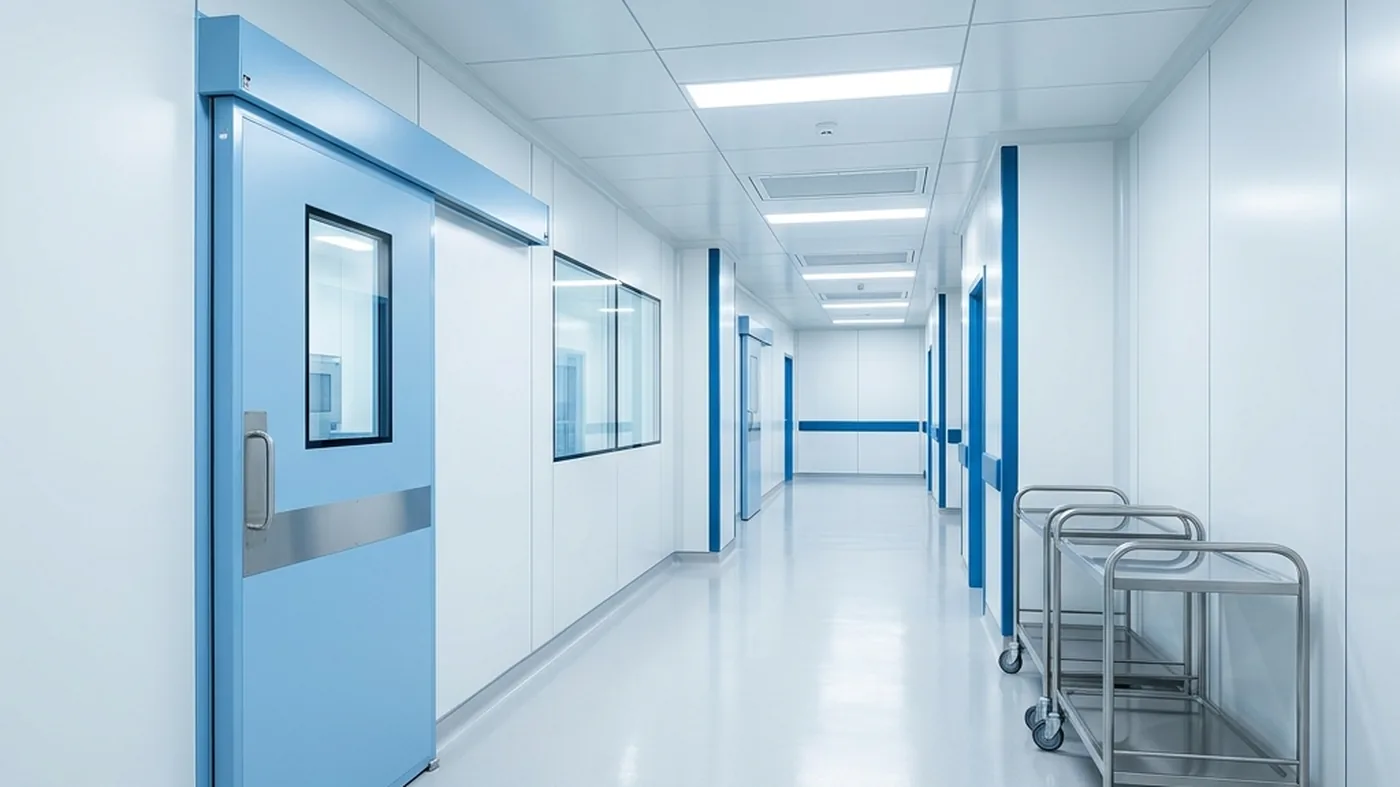
Gulf health authority inspectors and infection-control teams consistently focus on cleanability. The interior envelope should present no exposed joints, ledges or porous materials. In practice that means seamless wall panels with an antibacterial coating, flush-glazed observation windows, coved (radiused) junctions between floor, wall and ceiling, and seamless welded vinyl or resin flooring that turns up the wall as an integral skirting.
- Walls and ceilings: sandwich panels with smooth, chemical-resistant, antibacterial facings; silicone-sealed or gasketed joints; walk-on or framed ceilings that stay airtight around HEPA terminals.
- Doors: hermetically sealing automatic sliding doors for the patient route preserve pressure and allow hands-free trolley movement; hinged doors with drop seals suit scrub and staff entries.
- Lighting: sealed, flush-mounted cleanroom LED fittings (IP65 face) providing roughly 1,000 lux general illumination, supplemented by the surgical luminaire.
- Services: medical gas pendants, surgeon control panel, X-ray viewers and sockets should all be flush-mounted or pendant-hung so walls remain wipeable.
Room Sizes and Layout Adjacencies
Most international guidance puts a general operating theatre at around 36–42 m² of clear floor area, rising to roughly 50–60 m² or more for orthopaedic, cardiac and hybrid theatres that carry imaging equipment and larger teams, with a clear ceiling height of about 3 m to accommodate the UCV canopy, pendants and luminaires. Confirm minimum areas with your own authority's facility guidelines, as figures vary between emirates and ministries.
Adjacencies matter as much as area. A workable theatre suite places, directly off the theatre: a scrub-up bay (typically two positions) visible into the theatre; an anaesthetic induction room on the patient route; a sterile preparation/lay-up room for opening instrument sets; and a dirty utility/disposal room with a separate exit so soiled items never cross the sterile supply path. Planning these flows — patient, staff, sterile goods in, waste out — early in the modular layout avoids expensive redesign at authority review.
Commissioning and Validation: What Will Be Tested?
Before a theatre is licensed and at intervals thereafter, your authority will expect documented performance testing. A typical commissioning and validation scope, aligned with ISO 14644 and HTM-style acceptance testing, includes:
- Airflow volume and air-change rate measurement at each terminal, verified against design.
- HEPA filter installation leak testing (PAO/DOP aerosol challenge) on every terminal filter.
- Room pressure differentials across the full cascade, doors closed and during door operation.
- UCV canopy velocity and entrainment checks where ultra-clean ventilation is installed.
- Particle counts to the designed ISO 14644-1 class, at rest and, where required, operational.
- Recovery testing — demonstrating the theatre returns to its at-rest cleanliness rapidly after a challenge; many specifications look for recovery within about 20 minutes.
- Temperature, humidity, noise and lighting verification.
- Microbiological monitoring (active air sampling and settle plates) to the limits your authority or its referenced standard applies.
Our cleanroom validation in the GCC page explains how testing and documentation are organised for Gulf projects, including working with locally accredited test agencies.
Why Does Modular Delivery Shorten Hospital Downtime?
A modular theatre is fabricated as a panel-and-frame system off-site, then assembled inside the prepared shell. For a live hospital this changes the construction equation: wet trades, cutting and dust-generating work largely disappear from the clinical zone, the installation programme is measured in weeks rather than months, and adjacent departments — often still treating patients — face far less infection-control risk from builders' dust. Factory fabrication also means panels, doors and ceilings arrive with consistent, inspectable quality rather than depending on site workmanship, and the theatre can later be extended or reconfigured by adding panels rather than demolishing walls.
Pak Gusu ships complete modular theatre packages from Lahore to Jebel Ali, Dammam and Hamad ports on CIF or DAP terms, with installation supervision available as an additional service — see shipping and installation in the GCC and our guide to importing a cleanroom into the GCC for how delivery is sequenced.
Planner's Checklist: Specifying a Modular Operating Theatre
Use this checklist when preparing your specification or comparing supplier proposals:
| Item | What to specify or verify |
|---|---|
| Regulatory pathway | Licensing authority confirmed (DHA/DoH/MOHAP, MOH, MOPH); design-review and inspection stages mapped |
| Ventilation concept | Conventional (20–25 ACH) or UCV canopy, matched to the surgical caseload |
| Filtration | Terminal HEPA H13/H14 to EN 1822, with filter test certificates supplied |
| Pressure regime | Theatre positive to corridor (typically +15 to +25 Pa); dirty utility at cascade bottom; displays and alarms |
| Climate control | 20–24°C, 30–60% RH, with AHU sized for Gulf ambient conditions |
| Envelope finishes | Seamless antibacterial panels, coved floors, flush windows, sealed penetrations |
| Doors and interlocks | Hermetic sliding patient door, interlocked openings and pass-throughs |
| Size and adjacencies | 36–42 m² general / 50–60 m² specialty; scrub, anaesthetic, prep and dirty utility correctly placed |
| Commissioning evidence | Full test report pack: airflow, leak tests, pressures, particles, recovery, microbiology |
| Delivery and support | Incoterms, installation supervision, spares (filters, seals) and service plan agreed |
If you are at the budgeting or specification stage, request a quote with your theatre count, surgical disciplines and target programme, and our engineers will return a compliant modular proposal for your authority submission.
Related pages
Planning a cleanroom in the Gulf?
Get a free, no-obligation quote — export pricing, lead times and installation across the GCC.
Frequently Asked Questions
Common questions about cleanrooms, standards, cost and how Pak Gusu supplies and installs across the GCC.
How many air changes per hour does an operating theatre need in the UAE or Saudi Arabia?
Gulf health authorities generally accept internationally recognised ventilation standards, which put conventional operating theatres at around 20–25 HEPA-filtered air changes per hour — ASHRAE 170 requires a minimum of 20 total ACH, while HTM 03-01 designs conventional theatres at about 25 ACH. Theatres for orthopaedic and other implant surgery normally use an ultra-clean ventilation canopy instead, delivering unidirectional downflow over the surgical field. Always confirm the exact figure with your licensing authority before finalising the design.
What pressure should an operating theatre be relative to the corridor?
The operating theatre should be positively pressurised to the surrounding circulation space, typically by +15 to +25 Pa relative to the main corridor. The cascade steps down through the anaesthetic room, while the dirty utility room sits at the bottom — neutral or negative — so air never flows from soiled areas back towards the operating table. Differentials should be permanently displayed and alarmed, with interlocked doors protecting the cascade.
What is the difference between a conventional and an ultra-clean (laminar flow) operating theatre?
A conventional theatre uses turbulent, dilution-based airflow at roughly 20–25 air changes per hour and suits general surgery. An ultra-clean ventilation (UCV) theatre adds a large terminal-HEPA canopy over the table that delivers unidirectional downflow across the surgical field, achieving far lower airborne contamination — the approach normally specified for joint replacement, spinal and other implant surgery. UCV theatres correspond to DIN 1946-4 Room Class Ia and typically achieve ISO Class 5 conditions under the canopy.
Do modular operating theatres meet Gulf health authority requirements?
Modular theatres are licensed the same way as conventionally built ones: your local authority (such as DHA, DoH or MOHAP in the UAE, MOH in Saudi Arabia, or MOPH in Qatar) reviews the design and inspects the finished facility. A properly engineered modular theatre is designed to meet the same recognised references — HTM 03-01, ASHRAE 170, DIN 1946-4, ISO 14644 — and provides complete factory documentation that supports the submission. Pak Gusu supplies the technical file and commissioning evidence your regulator requires; approval itself always rests with the authority.
How big should a modular operating theatre be?
International guidance generally puts a general-purpose theatre at around 36–42 m² of clear floor area, with orthopaedic, cardiac and hybrid theatres at roughly 50–60 m² or more to accommodate imaging equipment and larger teams. A clear ceiling height of about 3 m is needed for the ventilation canopy, pendants and surgical lights. Minimum areas vary between Gulf authorities, so verify the figure in your regulator's facility guidelines.
How long does it take to install a modular operating theatre in a hospital?
Because the panels, doors, ceilings and air-handling components are fabricated off-site, on-site assembly of a modular theatre is typically measured in weeks rather than the months required for conventional construction, followed by commissioning and validation testing. This sharply reduces dust, noise and infection-control risk in a live hospital. The exact programme depends on shell readiness, theatre count and the validation scope agreed with your health authority.
Cleanrooms supplied & installed across the GCC
Manufactured in Pakistan with GUSU (China) technology · shipped to Jebel Ali, Dammam & Hamad (CIF/DAP) · installation available across the Gulf.